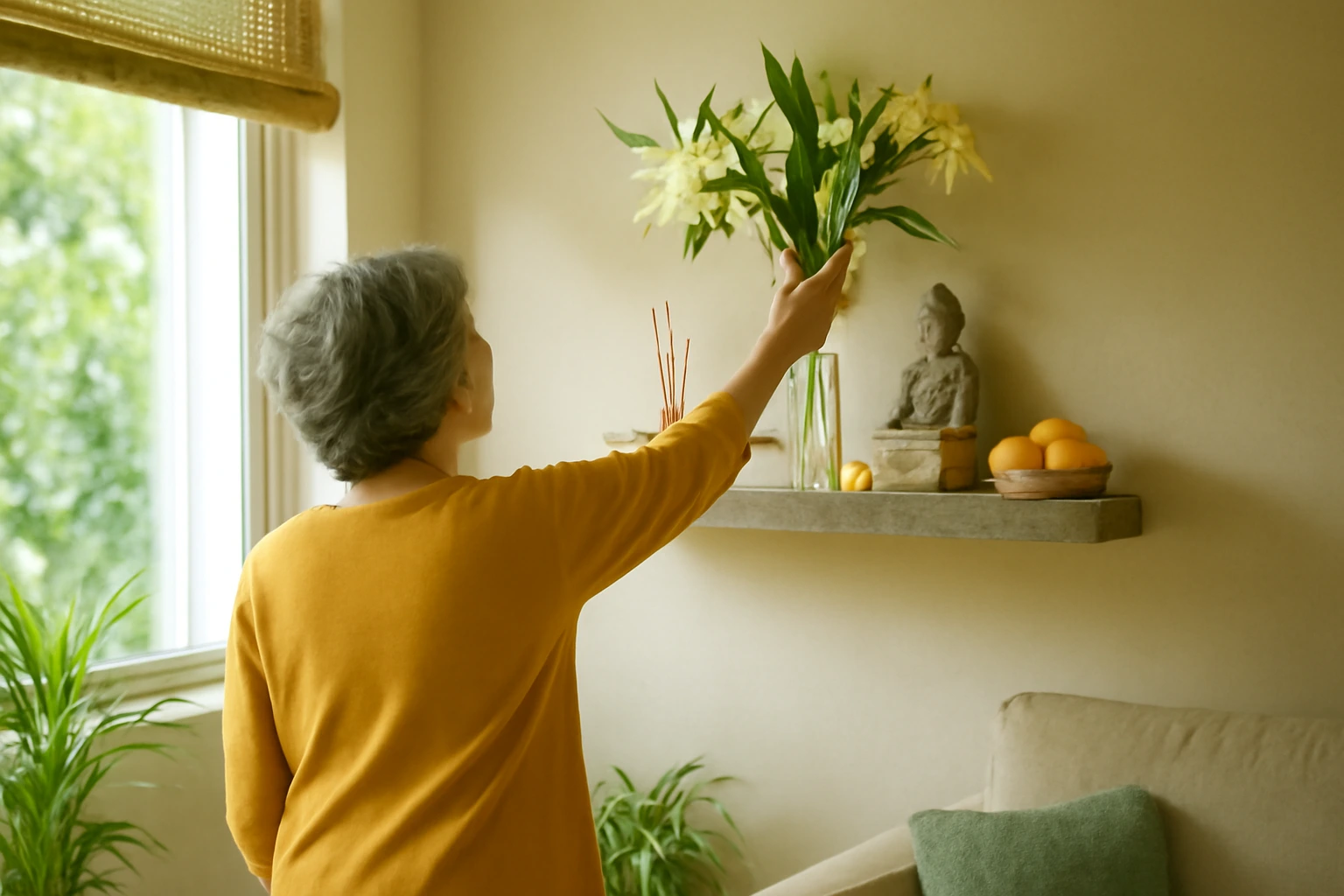
Where to place an ancestor altar in a Vietnamese townhouse or apartment, and how to mount one safely
Short answer: a Vietnamese ancestor altar should sit somewhere dignified and quiet, with its back against a solid wall. The most common taboos are: not against or sharing a wall with a toilet, not directly under a cross beam, not facing the front door or a bathroom door head-on, not below a bedroom or walkway, and not right beside a bed. In small apartments, a wall-mounted altar is the usual solution, but it must be fixed with anchors suited to the wall and the weight it will carry.
If you are a foreign partner in a Vietnamese household, or renting a place where the landlord's altar stays, these rules explain a lot of furniture decisions that might otherwise look odd.
Why placement matters so much
For Vietnamese families the altar is where the living meet their ancestors. Its position has to show respect: high, clean, quiet, and not exposed to the indignities of daily life. Most of the taboos below come from that idea, rather than from compass calculations.
Common taboos and the reasons behind them
| Avoid | Folk reason | Practical side |
|---|---|---|
| Sharing a wall with a toilet | Something unclean next to something sacred | Damp walls, smells, mould creeping onto the altar |
| Under a cross beam | The beam "presses down" on the ancestors | Feels heavy, awkward for lighting |
| Facing the front door | Energy rushes straight in | Draughts blow out incense, street dust settles |
| Below a bedroom or walkway | People stepping over the ancestors' heads | No technical reason; purely a matter of respect |
| Next to a bed | Not dignified | Incense smoke in a closed bedroom |
Many taboos turn out to make domestic sense too. The rule about nobody above the altar is pure respect, and it is why tube houses so often put the altar room on the top floor.
Which way should it face?
Two lines of thinking are common. One turns the altar towards one of the head of household's favourable directions under the Eight Mansions system. The other has the altar "sit" somewhere solid and "look out" towards the door or the brightest part of the home, like grandparents seated in the place of honour watching over the family.
In a townhouse or apartment there are usually only one or two walls that work, so many families choose a solid, suitable wall first and think about direction second. An altar in the "right" direction that is propped up beside a bathroom reassures nobody.
Altars in apartments
In an apartment there is always someone living above you. The "nobody above" rule is therefore interpreted loosely: pick a quiet corner of the living room or a small spare room, avoid sitting directly below the upstairs neighbour's bathroom if you know where it is, and, as many families do, add a small decorative ceiling panel above the altar as a symbolic "roof".
- Wall-mounted altar (bàn thờ treo): compact, leaves the floor free, hung above standing eye level.
- Small standing altar cabinet: suits a dedicated prayer room.
- Top of a tall cabinet: works if the top is solid and the space below is kept tidy.
Sizes and the Lỗ Ban ruler
Many Vietnamese altar makers build to lengths that fall on lucky intervals of the thước Lỗ Ban, a traditional carpenter's ruler named after a legendary Chinese craftsman. Lengths you will often see quoted are 127, 153, 175 and 197 cm. It is a craft convention. What matters more is that the altar fits the wall, holds the incense bowl, lamps, flowers and fruit without crowding, and is at a height where older relatives can light incense without standing on tiptoe or climbing on a chair.
Elderly people climbing on chairs, often plastic ones, to reach a high altar is a common cause of falls. If the altar is too high, add a sturdy step or lower it.
Mounting a wall altar safely
A hanging altar loaded with an incense bowl, brass items and fruit can be surprisingly heavy, and one falling off the wall is genuinely dangerous, not just inauspicious.
- Identify the wall: solid brick, hollow brick, concrete or plasterboard. Plasterboard cannot carry a heavy altar without a reinforced frame.
- Use expansion anchors or bolts rated for that wall and the load, in the number the manufacturer specifies.
- Avoid drilling into hidden electrical cables or water pipes; check the building's plans or use a detector.
- In a rental, ask the landlord before drilling.
If you are not sure the wall can take the load, get an experienced installer or an engineer to look. Do not rely on a salesperson saying "anyone can hang this one".
Incense smoke in sealed rooms
Apartments with windows closed and air conditioning running hold incense smoke for a long time. Open a window when lighting incense, use fewer sticks, choose thin sticks or slow coils, and do not put an altar in a small child's bedroom. If anyone at home has a respiratory condition, ask a doctor about regular smoke exposure; some families switch to electric incense lights for daily use and keep real incense for special days.
Renting a house that already has an altar
In Vietnam it is not unusual to rent a whole tube house where the owner's ancestor altar stays in place, often in the top-floor room. Agree on the details before you sign: who lights incense, whether the owner's family will come on the first and fifteenth of the lunar month, and whether you may dust the altar. Do not move the incense bowl or altar objects yourself; if you need the room rearranged, ask the owner to do it. If you want to set up an altar of your own, for example for a Vietnamese partner's family, put it in a different room rather than next to or on top of the owner's, and ask before drilling.
Many expat tenants find this arrangement easier than expected. A landlord who visits twice a month to light incense is also a landlord who notices a leaking roof early, and a little flexibility tends to be returned.
If your family is looking for a compact model for an apartment, wall altars at Vật Phẩm Phong Thủy, a Vietnamese-language shop that delivers within Vietnam, is one place to compare sizes; measure the wall before choosing.