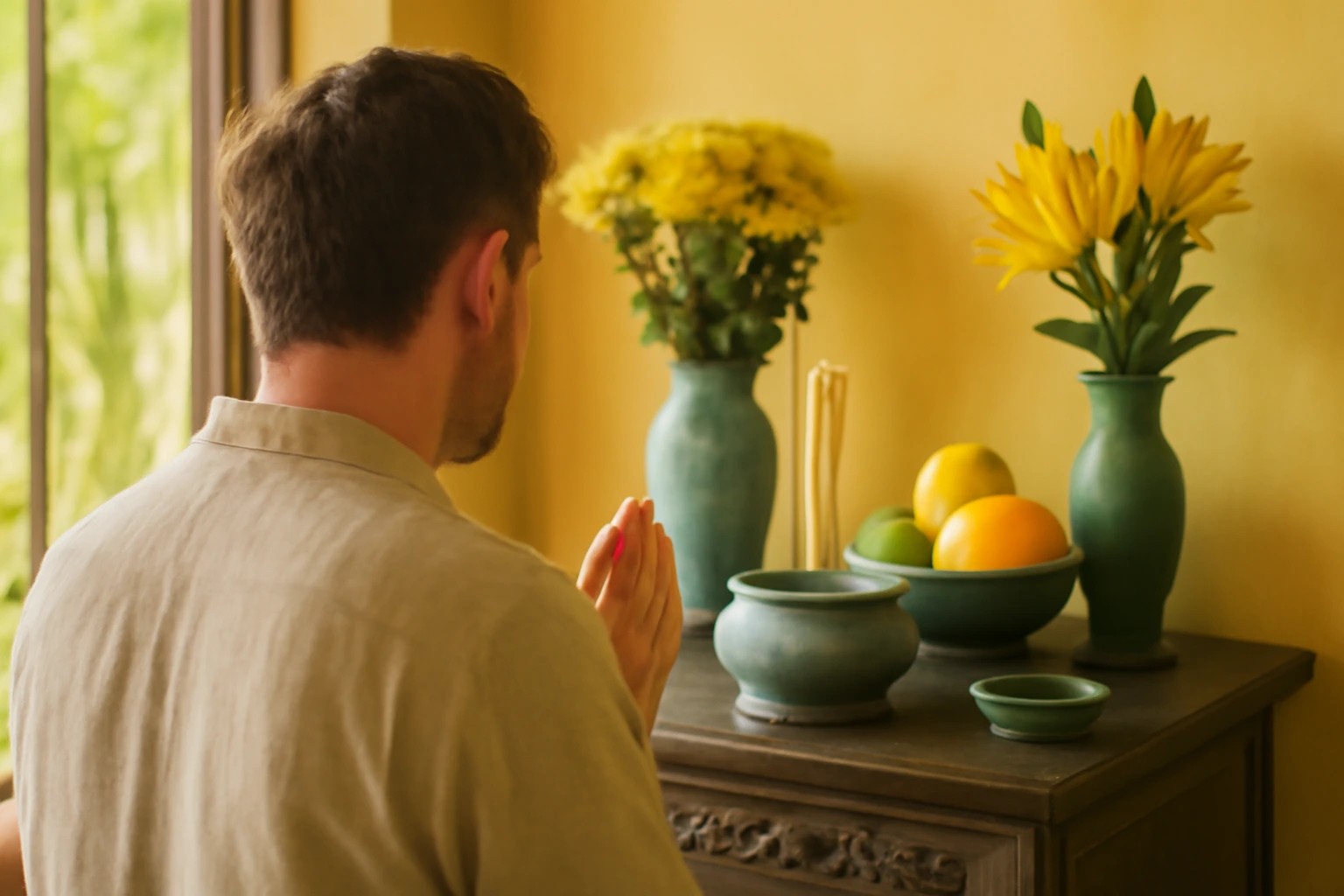
What is on a Vietnamese ancestor altar: incense bowl, portraits, lamps, flowers and fruit explained
Short answer: a Vietnamese ancestor altar, bàn thờ gia tiên, usually holds an incense bowl at the centre, portraits or name tablets of the deceased at the back, a pair of lamps or candles, small cups of clean water, a vase of flowers and a plate of fruit. Many also have rice wine, betel leaves and areca nuts, and a holder for incense sticks. The common arrangement is tall items at the back and low items at the front, with the incense bowl in the middle, flowers on one side and fruit on the other. Details vary by region and by family, so if there are elders in the house, their way comes first.
Honouring ancestors is one of the most widespread practices in Vietnam, across people who call themselves Buddhist, Catholic, or nothing in particular. For a foreigner living with or marrying into a Vietnamese family, the altar is where the family's relationship with its dead is made visible every day.
The incense bowl: the heart of the altar
The incense bowl, bát hương, is where incense sticks are placed each time someone prays. For many families it is the most important object on the altar. It is consecrated once, when the altar is set up, and filled with clean ash or sand and sometimes other items according to family custom. Once installed, people avoid moving, turning or lifting it casually.
The number of bowls varies. One shared bowl for all ancestors is common. Some families keep three, with the centre one for the ancestors or guardian spirits in general and the side ones for particular branches or for relatives who died young. If you are unsure, ask an elder rather than adding one yourself.
Portraits and name tablets
Portraits of the deceased, di ảnh, stand at the back, highest on the altar. In many northern homes there is also a wooden name tablet, bài vị, recording the person's formal name and date of death, kept in a small shrine cabinet. Southern homes often display many photographs: grandparents, parents, sometimes siblings who have passed away.
With several portraits, the older generation usually sits higher or in the centre. Wipe frames with a soft dry cloth and keep them out of long direct sunlight, which fades old photographs.
Lamps, candles and fire safety
The pair of lamps on either side is often explained as the sun and the moon. Traditionally these were oil lamps or candles; today many households use electric candle lamps that stay on.
If your family uses real flame: put it on a stable base, away from curtains, picture frames and paper decorations, and never leave it burning when everyone goes out or goes to bed. Altars sit high and are full of wood and paper, so a tipped candle can start a fire quickly. Electric lamps should run from a sound socket with cables tucked neatly behind, not from an overloaded power strip.
Water, rice wine and betel
A cup of clean water is the simplest offering and appears on almost every altar. Many families use three cups, some one or five, and change the water on the first and fifteenth of the lunar month or daily, depending on habit. Rice wine is poured into small cups during offerings. Betel leaves and areca nuts appear on death anniversaries, at Tết and at weddings, a reminder of an old custom of offering betel to guests.
Water left standing in a hot, humid house gets cloudy, so change it often and rinse the cups. It is a small act, but it is what makes an altar feel looked after.
Flowers, fruit and "vase east, fruit west"
A Vietnamese phrase, đông bình tây quả, means vase on the east, fruit on the west. The usual reading takes directions from the altar's point of view looking out, so a person standing in front of the altar sees flowers on their right and fruit on their left. Plenty of families do it the other way round and have done for generations, so do not worry if yours differs.
Altar flowers are usually fresh and lightly scented: chrysanthemums, tuberoses, lotus, roses, gladioli. Many families avoid artificial flowers on the ancestor altar, though some use silk ones so they never wilt. Fruit should be washed and dried; bruised fruit draws ants and flies.
How the layers usually go
- Back row: portraits, name tablets, shrine cabinet.
- Middle: incense bowl in the centre, lamps on either side.
- Front: water cups, wine cups, betel plate.
- Outer sides: flowers on one side, fruit on the other.
- Incense holder and lighter: tucked in a corner, away from dry flowers.
The general rule is not to block the incense bowl or the portraits, keep the surface uncluttered, and never use the altar as a shelf for keys, phones or paperwork. Guests sometimes do this without thinking; it is noticed.
Altars with the Buddha or other deities
Some families also keep a statue of the Buddha, the bodhisattva Quan Âm (Guanyin), or another deity. Many pagodas advise placing the Buddha higher than and separate from the ancestors, or on the top tier of a multi-level altar. Statues belong somewhere clean, never on the floor, not with their back to the door, and not beside meat offerings.
Shops in the south often have a separate low altar for the God of Wealth (Thần Tài) and the Earth God (Ông Địa), placed at floor level facing the door. That is a different tradition and is kept apart from the ancestor altar.
Etiquette for guests and new family members
- When visiting a family home on a death anniversary or at Tết, it is a kind gesture to light incense at the altar. Ask first; someone will show you how.
- Hold the lit sticks with both hands, bow slightly a few times, then place them in the bowl. Use an odd number of sticks, usually one or three.
- Do not point your feet at the altar when sitting on the floor, and do not touch the incense bowl or portraits.
- Bringing fruit or flowers for the altar is a thoughtful gift; the family may place it there before sharing it later.
Families who need to replace an incense bowl or altar set can browse incense bowls at Vật Phẩm Phong Thủy, a Vietnamese-language shop delivering within Vietnam, but replacing an existing bowl involves a ritual, so ask the elders first.