Living in a Vietnamese tube house: light, airflow and clear paths through a narrow, deep home
Short answer: the Vietnamese tube house, nhà ống, is a narrow, deep townhouse squeezed between its neighbours. Its usual weak points are a dark middle, poor airflow and a ground floor blocked by motorbikes and furniture. Feng shui describes this as energy that cannot circulate; an architect would call it poor daylight and ventilation. The fixes overlap almost entirely: a lightwell or open void in the middle, openings at both front and back so air can move through, a clear path from the front door to the back, and a second escape route in case of fire.
If you are renting or buying one, this is the lens Vietnamese owners will use when they talk about the house being "good" or "bad", and it is also a practical checklist for daily comfort.
Why tube houses are so narrow
In old trading streets, frontage was where business happened, so it was the valuable part of a plot. Every household wanted its own shopfront, and land was divided along its depth. The result is houses a few metres wide and many times as deep, with solid party walls shared with the neighbours on both sides. Hanoi's Old Quarter still has very long "tube" houses broken up by small inner courtyards; newer townhouses usually cover the whole plot and grow upwards, four or five storeys or more.
Solid side walls mean light and air can only come in from the front, the back and the roof. Everything below follows from that.
The dark middle, where feng shui and design agree
Feng shui favours a bright open space in front, the "bright hall" or minh đường, and dislikes areas that never see sunlight. Tropical architecture worries about damp, mould and smell. Both point to the same answer: the giếng trời, literally "sky well", a lightwell cut through the floors.
- Position: usually around the middle of the house or next to the stairs, so daylight reaches the middle floors, which are the darkest.
- Roof: glass or an openable skylight lets light in while keeping rain out. A fully sealed top turns the well into a heat chimney that cannot vent.
- Plants: a few pots at the bottom of the well cool the space and are seen in folk belief as bringing "living energy". Choose plants that tolerate partial shade, set them firmly, and avoid heavy hanging pots above walkways.
If the house is already fully built, a small void beside the staircase is sometimes added. Cutting a floor slab is structural work and must be calculated by an engineer, whatever any feng shui advice suggests.
Air that moves: front door, back door and a way out for heat
Air only passes through a building if it has a way in and a way out. A tube house with an open front and a sealed back stays stuffy however wide the front door is. There is a folk saying that if the front and back doors line up, money comes in the front and goes straight out the back. The usual compromise is not to close the back, but to offset it slightly or place a screen, a low shelf or a large plant so the draught bends once instead of rushing straight through.
This is a good example of a folk belief with a sensible version underneath: a straight blast of wind from street to kitchen blows papers about and carries road dust inside. Turning it once makes the house more comfortable.
The front door and the motorbikes
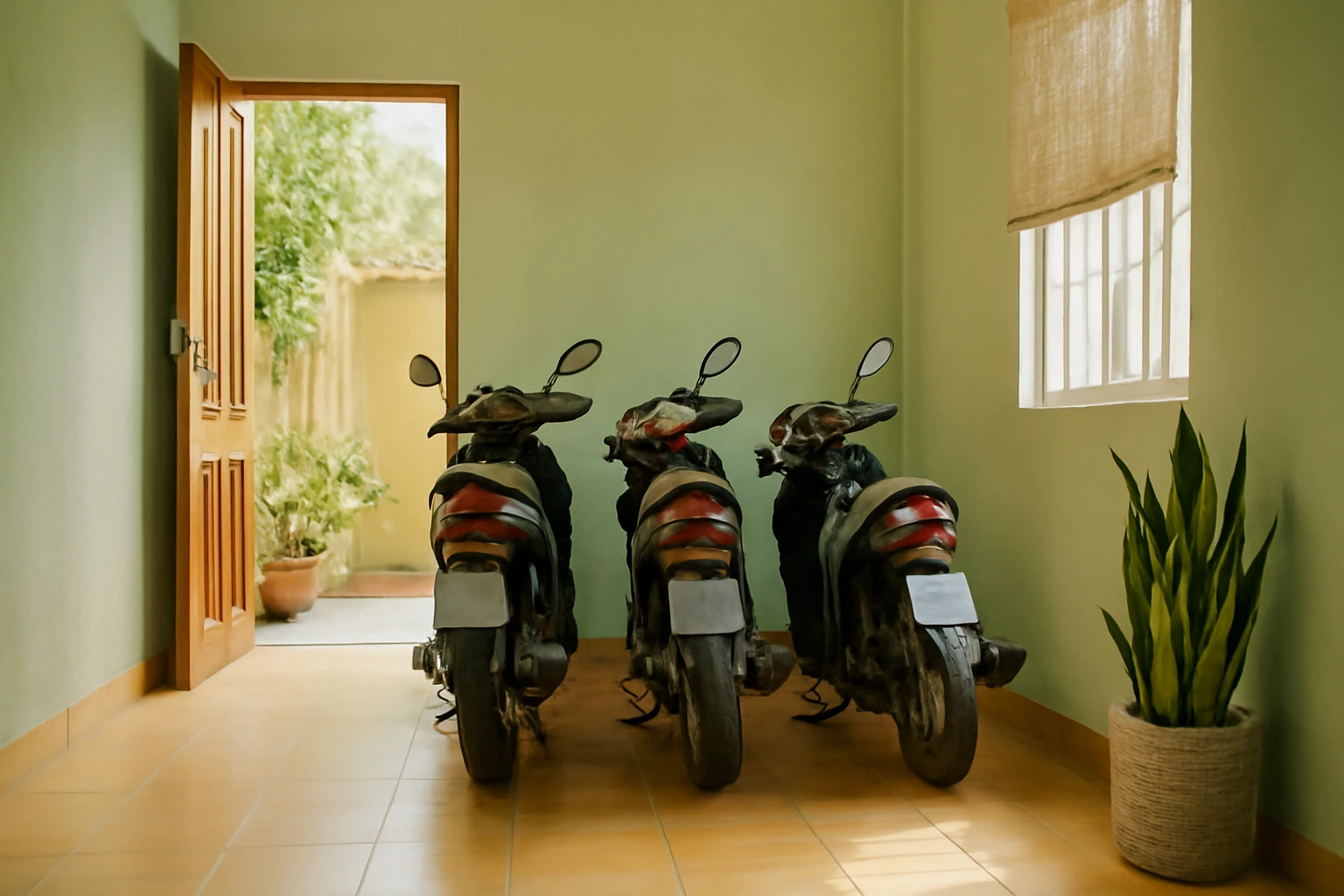
In a Vietnamese townhouse, the ground floor is the living room by day and the garage by night. Two or three motorbikes parked across the path from the door is a familiar sight, and foreign tenants are often surprised the first time they see it. In feng shui terms, the front door is the "mouth" of the house where energy enters, and the space just behind it should be open. In safety terms, it is your escape route.
- Park bikes against one wall and keep a straight path, at least one person wide, to the door.
- Do not leave electric scooters charging overnight near the exit with no one awake. Many tube-house fires start in the parking area.
- Make sure the front door can be opened quickly from inside, with the key kept in one fixed spot everyone knows.
Some owners size their doors using a thước Lỗ Ban, a carpenter's ruler marked with lucky and unlucky intervals. It is a craft tradition that does not affect safety, but the door still needs to be wide enough for bikes and people.
A second way out matters more than any good direction
Tube houses often have only one exit on the ground floor, and upper balconies and windows are enclosed in steel security grilles. If a fire starts downstairs, people upstairs can be trapped. Vietnamese fire authorities have repeatedly warned about exactly this.
No feng shui school covers it, but it cannot be skipped. At least one upper window or balcony grille should have a panel that opens from the inside, ideally with an escape ladder or access to a neighbouring roof agreed with the neighbours. If you are renting, ask the landlord about this before you sign, and get professional advice before altering anything.
What goes on which floor
| Floor | Common use | Notes |
|---|---|---|
| Ground | Bike parking, living room, kitchen at the back | Kitchen near the lightwell or back door to vent smells |
| Middle | Bedrooms | The darkest floors; need the lightwell or front and back windows |
| Top | Altar room, laundry terrace | Nobody lives above the altar |
Putting the altar room on the top floor is a very Vietnamese answer to the rule that no one should walk above the ancestors. It has a cost: elderly relatives climb several flights to light incense. Families with frail grandparents sometimes place the altar lower, in a quiet room with storage or a terrace above it, which keeps the sense of respect.
If you rent a house with an altar room on the top floor, the landlord's family may ask to come in on the first and fifteenth of the lunar month to make offerings. Agreeing on this in advance avoids awkwardness later.
Wind chimes, mirrors and other hanging things
Because tube houses are narrow, people are often told to hang wind chimes at the door or put a mirror at the end of a corridor to make the space feel bigger. A large mirror can genuinely brighten a dim hallway, though folk custom avoids one directly facing the front door. A chime hung indoors rarely gets enough breeze to ring; at a front window, choose a soft tone, since your neighbours are on the other side of a shared wall.
If you want a small chime for a window or lightwell, the wind chime section of Vật Phẩm Phong Thủy, a Vietnamese-language shop that delivers within Vietnam, has a range; fix it securely and away from walkways.