Room by room in a Vietnamese tube house or small apartment: living room, bedroom, balcony and storage
Short answer: in a Vietnamese tube house or a small apartment, arranging each room by feng shui comes down to three things. Where you sit and sleep should have a solid wall behind you and a view of the door without being directly in its path. Walkways should stay clear. Rooms need light and moving air. Most of the familiar taboos, such as a bed under a beam, a mirror facing the bed or a sofa with its back to the door, can be explained in terms of sleep, safety and feeling at ease.
Earlier pieces on this site covered light and airflow in tube houses, the stairs, kitchen and toilet, and how to choose an apartment. This guide goes inside, room by room: the living room, the bedroom, rooms for children and older relatives, the balcony and the storage corners. It also shows how to rearrange a room when you are renting and cannot knock anything down.
Three principles that work in every room
Before going room by room, it helps to know three principles that nearly every feng shui school and every residential architect agree on, even if they use different words for them.
- Something solid behind you. Whether sitting or lying down, you are better off with a solid wall at your back. Feng shui calls this having a "mountain" behind you. Environmental psychology puts it more plainly: people relax when their back is covered.
- A view of the door. From your main seat and from your bed, you should be able to see the entrance without lying straight in the line of the door as it opens. Feng shui books call this the command position.
- Clear paths. The route from the door to the window, the balcony and the stairs should not be blocked by wardrobes, motorbikes or boxes. Folk belief says energy must flow; in practice it means nobody trips, and everyone can get out quickly in an emergency.
For the specific problem of getting light and air into a long, narrow house, see living in a Vietnamese tube house. Everything below assumes a home where the basic paths are open and daylight gets in.
The living room: where guests sit and, often, where the bikes live
In a city tube house, the ground-floor living room usually doubles as the motorbike garage and sometimes as a small shop. In an apartment, it usually shares space with the dining table and the kitchen. That means you cannot follow a textbook layout. You have to set priorities.
The sofa and the host's seat
The main seat should back onto a solid wall, not onto the front door or the staircase. If the room is too narrow for that, a low shelf or cabinet behind the sofa creates a sense of backing. The person sitting feels sheltered, and guests coming in do not have to walk behind the host.
Motorbikes indoors
Park bikes tight against one wall and keep a walkway wide enough for two people to pass. Never park in front of the stairs or the back door. There is petrol in every tank, so do not charge phones on a socket right beside the bikes, and keep any shop altar or incense well away from where they stand.
An altar in an apartment living room
Apartments have no top floor of their own, so many families mount the ancestor altar in the living room. Placement, height and mounting are covered in a separate article on altars. For the living room specifically, avoid putting it on the same wall as a large television, directly above the sofa where people lean back, or anywhere without space in front to stand and light incense.
The bedroom: the room that matters most for daily health
If you only have the energy to fix one room, fix the bedroom. You spend roughly a third of your life there, and the bedroom taboos are the group with the clearest practical logic behind them.
Where the bed goes
- Headboard against a solid wall. Not under a window, where draughts and street noise land right on your head.
- Not under an exposed beam. Folk belief links beams overhead to headaches and quarrels. Practically, a beam above your face feels oppressive, and in older houses the area under a beam is often where cracks and damp appear.
- Feet not pointing straight out of the door. In Vietnam this is called the "coffin position", because the dead are carried out feet first. It is purely cultural, but many people find it uncomfortable, so if you can turn the bed, do.
- Not against a wall shared with a bathroom. Feng shui calls it unclean energy. In reality it means flushing noise at night and damp creeping through the wall.
- Access from both sides. For couples, pushing one side of the bed against a wall means one person climbs over the other at night. It sounds trivial, but it affects sleep.
Mirrors, televisions and things on the wall
The rule against a mirror facing the bed is widely known. The folk explanation is that mirrors bounce or draw energy. The easier-to-test explanation is that waking at night and seeing movement in a mirror makes people jump. A wardrobe mirror can be turned to face inwards, covered with frosted film or hidden behind a light curtain. A switched-off television also acts as a reflective panel, and its light makes it harder to fall asleep.
Heavy things such as large glass-fronted frames, bookshelves or the air-conditioning unit should not sit directly above the bed. If they must, they need to be properly screwed into the wall, not hung on adhesive hooks.
Rooms for children and older relatives
With these two groups, think about safety first and taboos second.
Older relatives should sleep on the lowest floor possible, close to a toilet, with a small night light along the path. In a four- or five-storey tube house, putting grandparents on the top floor beside the altar "to be near the ancestors" exposes them to a fall on the stairs every single day. The altar can stay upstairs while they sleep on the second floor and go up to light incense when someone can accompany them.
Small children need window guards, shelves and wardrobes anchored to the wall so they cannot topple, and covered sockets. Do not put a child's bed directly under a window or beneath a high shelf of toys. Small feng shui items such as coins, beads and crystal chips belong out of reach, because children under three can swallow them. You will rarely find that advice in a feng shui book, but it matters more than any bed direction.
The windowless middle room of a tube house
Deep tube houses often have a middle room with no external window, only a vent or an opening onto the lightwell. Many families use it as a bedroom. Feng shui calls this stagnant energy; an architect would call it a room short of fresh air and prone to mould.
If someone has to sleep there, keep the door ajar when possible, fit an extractor or ventilation fan, and do not let a wardrobe block the only vent. Never burn charcoal, use a fuel-burning heater or leave incense burning in that room overnight. Smoke and fumes in a sealed room are not a feng shui issue; they are a poisoning risk.
Balconies and loggias
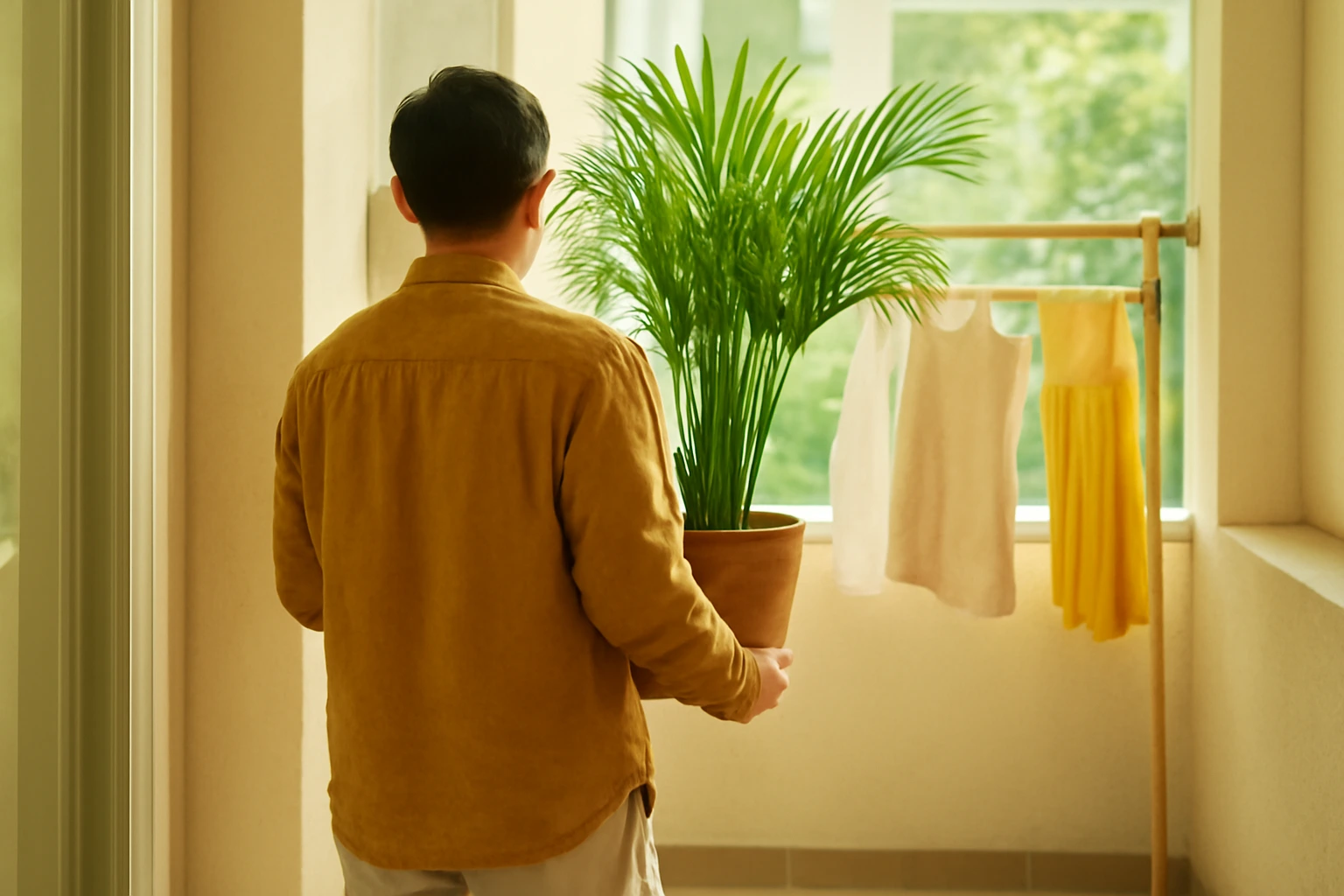
Apartment balconies usually do three jobs at once: drying laundry, housing the washing machine and holding plants. Feng shui treats the balcony as the place where energy enters, and recommends keeping it open, green and free of junk. That happens to match safety advice: in many apartment blocks the balcony is a fallback escape point in a fire, and it is the main light source for the living room.
- Keep heavy pots at the foot of the wall, never hanging over the railing.
- Do not put chairs, crates or tall pots against the railing, where children can climb them.
- If you hang a wind chime, choose a soft one so the neighbours are not kept awake.
- Do not burn paper offerings on an apartment balcony. Use the building's designated burning spot if there is one.
Storage, the space under the stairs and forgotten corners
Feng shui strongly dislikes clutter, which it describes as energy getting stuck. There is a checkable reason too: corners piled with old things collect dust, damp, cockroaches, rats and termites, and they burn easily if wiring runs nearby. In tube houses the space under the stairs often becomes a storeroom or even a toilet, which we discussed in stairs, kitchen and toilet in a tube house.
The practical habit is to clear storage once a year, which many Vietnamese families do during the big clean before Tết. Throw out what you have not used in a year, keep the rest in lidded boxes, and let the space breathe. Never store spare gas bottles, petrol or paint under the stairs, because the staircase is the main escape route in a fire.
Quick reference: room by room
| Room | Folk taboo | Practical reason behind it | Fix when you cannot renovate |
|---|---|---|---|
| Living room | Sofa backing onto the door | Unease, people passing behind you | Low shelf behind the sofa |
| Living room | Bikes blocking the entrance | Trips, blocked escape | Park tight along one wall |
| Bedroom | Bed under a beam | Feels oppressive, cracks and damp | Move the bed or add a false ceiling |
| Bedroom | Mirror facing the bed | Being startled at night | Turn it, frost it or curtain it |
| Bedroom | Feet towards the door | Purely cultural | Turn the bed if easy, otherwise let it go |
| Middle room | Stagnant energy | Poor ventilation, mould | Fan, open door, nothing burning |
| Balcony | Clutter | Blocked exit, lost daylight | Keep only plants and laundry |
| Storage, under stairs | Mess | Pests, fire risk | Yearly clear-out, no fuels |
Rearranging a bedroom in one afternoon
- Photograph the room and sketch a plan. Mark the door, window, beams, sockets, air conditioner and any wall shared with a bathroom.
- Pick the headboard wall. Solid, not under a window, not shared with a bathroom if you can avoid it.
- Lie down and look out. From the new position, can you see the door? Does it swing straight at your face?
- Deal with mirrors and screens. Turn, cover or move them to another wall.
- Clear under the bed and the top of the wardrobe. Heavy boxes on top of a wardrobe can fall when doors are slammed.
- Walk the night route. From bed to door and to the bathroom with no obstacles, plus a small night light.
- Sleep on it for three to five nights. How it actually feels matters more than any chart.
A worked example: a young family's two-bedroom flat
A couple with a toddler rent a two-bedroom apartment. The main bedroom has a big window on the end wall, so they put the headboard right under it for the "fresh air". The wardrobe opposite the bed has mirrored doors. The small room is for the child, with the cot beside an unguarded window.
After working through the steps above, the main bed moves to the solid wall at right angles to the window. They can still see the door, and the breeze now crosses the foot of the bed instead of blowing on their heads. The wardrobe mirrors get a frosted film. The cot moves to the inner corner, the window gets a guard and the toy shelf is screwed to the wall. Nothing was bought to "remedy" anything. The wife says everyone sleeps better a few weeks later. That proves nothing about feng shui, but it shows that small changes with a practical reason are usually worth doing first.
Common mistakes
- Buying objects before moving furniture. Turning a bed or shifting a shelf often solves the problem.
- Moving grandparents upstairs to be near the altar. The trade-off is a daily fall risk.
- Mirrors everywhere to "open up" a small flat. In tight spaces they add glare and surprises.
- Blocking the only vent with a wardrobe. Tidier to look at, but the room turns damp and stuffy.
- Following a chart without sleeping on it. Every room has its own sun, wind and noise; you only learn them by living there.
When to bring in a professional
Before cutting a window into a middle room, building a false ceiling to hide a beam, or drilling a heavy shelf into an apartment wall, ask an engineer or the building management, because many walls carry pipes, buried cables or structural loads. Rewiring or adding a socket for a night light is a job for an electrician. If someone in the house has a persistent cough, breathing trouble or allergies in a damp room, see a doctor and check for mould rather than just turning the bed. And if your family wants a layout reading in a specific school such as Eight Mansions, an experienced practitioner can help. If you also need a desk at home, our guide to a home office in a Vietnamese apartment or tube house deals with keeping work away from the bed.
Once the room is sorted, some families like to add a small guardian figure to the living room shelf for its looks and for reassurance. The Vietnamese shop Vật Phẩm Phong Thuỷ, which delivers within Vietnam, has a range of feng shui guardian figures; pick one that fits the shelf, sits securely and stays out of small children's reach.