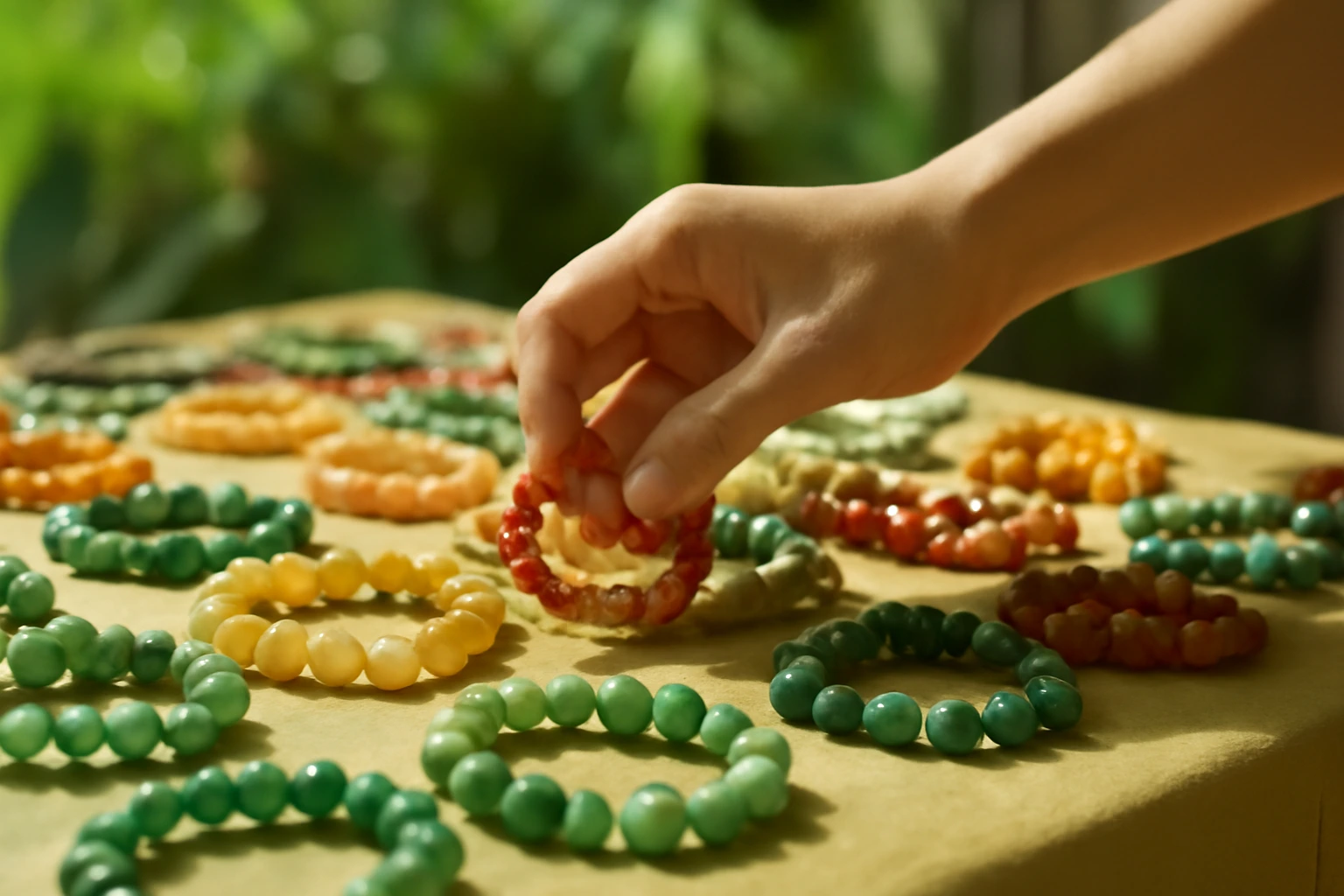
Buying a feng shui stone bracelet in Vietnam: what is belief and what you can actually check
Short answer: choosing a stone bracelet because its colour suits your birth element, or because a stone is said to "carry energy" or "attract wealth", is folk belief and cannot be tested. What the stone actually is, whether it has been dyed, whether it is reconstituted from powder or is simply glass, and whether it is cracked inside, can all be checked, by eye, with simple tools, or with a report from a gem testing laboratory. Keep the two apart: choose by meaning if the meaning appeals to you, but pay according to the material.
Stone bead bracelets are everywhere in Vietnam, from market stalls to jewellery shops and online live-streams, and many foreigners buy one as a souvenir or gift. This guide explains how Vietnamese buyers think about them and how to avoid paying gemstone prices for glass.
The belief side: colour and your birth element
Most Vietnamese buyers choose by mệnh, their element according to the year of birth in the lunar calendar. Each person is assigned one of the five elements, ngũ hành: Metal, Wood, Water, Fire or Earth. Colours are then matched along the "generating" cycle of the elements. Roughly, Metal suits white, grey and yellow; Wood suits green and black; Water suits black, blue and white; Fire suits red, pink, purple and green; Earth suits yellow, brown and red. Individual stones carry their own meanings too: amethyst for calm, tiger's eye for decisiveness, rutilated quartz for career.
These meanings are part of the culture and matter to people who hold them. They cannot be tested, though, and sellers often disagree about the same stone. If someone tells you a bracelet "does not suit your element", treat it as an opinion, not a reason to worry or to buy another one.
The testable side: natural, treated or fake
| Type | What it is | Common signs |
|---|---|---|
| Natural stone | Mined, cut and polished, no colour treatment | Colour and pattern vary between beads; tiny natural inclusions inside |
| Dyed stone | Pale natural stone soaked in dye | Colour concentrates in cracks and around drill holes; may bleed onto a cotton pad with alcohol |
| Reconstituted stone | Stone powder mixed with resin and pressed | Repeating patterns, identical beads, lighter than solid stone |
| Glass or plastic | Man-made imitation | Round gas bubbles, warms quickly in the hand, light |
These are clues, not proof; non-specialists often guess wrong. For anything expensive, the reliable route is a gem testing laboratory, which measures refractive index and specific gravity and examines the stone under magnification.
Hardness and scratches
Quartz varieties, including amethyst, rose quartz, rutilated quartz and tiger's eye, have a hardness of about 7 on the Mohs scale, harder than ordinary glass. That is why a genuine quartz bracelet resists everyday scratches from dust and sand. Some other popular materials are softer or porous, such as turquoise, moonstone and amber, and scratch or absorb liquids more easily.
Avoid the market-stall habit of scraping a bead with a knife or dragging it across glass "to prove it is real". It can damage the piece and does not settle the question.
Reading a testing certificate
A trustworthy report names the material in mineralogical terms, notes any treatment such as "dyed" or "impregnated", includes a photo of the exact item, its dimensions and weight, and has a reference number you can verify with the issuing lab. Be cautious if:
- The paper only says "natural stone" without naming the mineral.
- The photo does not match the bracelet in your hand.
- There is no way to check the reference number with the issuer.
Looking after a bracelet in a tropical climate
- Take it off for showers, swimming and washing up. Soap and chlorinated pool water dull porous stones and perish the elastic cord.
- Do not leave it in strong sun for long periods; some coloured stones, amethyst included, can fade.
- Wipe with a soft, slightly damp cloth and let it air-dry.
- Replace the elastic as soon as it looks stretched or whitened, before it snaps and scatters beads.
- Store pieces separately in cloth pouches so hard stones do not scratch soft ones.
Vietnamese sellers may suggest "recharging" a bracelet by soaking it in salt water or leaving it under the full moon. These are beliefs. Salt water in particular can harm porous stones and metal parts; if you want to follow the custom, the gentler version is leaving the bracelet on a windowsill overnight.
Left wrist or right?
Vietnamese sellers will often tell you to wear a feng shui bracelet on the left wrist, explaining that the left hand "takes in" and the right hand "gives out"; pi xiu bracelets in particular are usually recommended for the left. This is folk belief, and plenty of people ignore it. A practical rule works just as well: wear it on the hand you use less for writing, typing and lifting, because a bracelet on your dominant hand knocks against desks and laptops, scratches faster and wears out its cord sooner. A good fit lets the bracelet turn freely with room for one finger between beads and skin.
Health and safety
No stone treats illness. Claims that a stone "regulates blood pressure" or "cures insomnia" have no basis; anyone with a health concern should see a doctor. Some people react to metal clasps or dyed cord, so take a bracelet off if your skin turns red or itchy. Keep small-bead bracelets away from young children, since a broken cord scatters beads that can be swallowed or pushed into noses and ears.
Sales pitches to recognise
You may hear lines that play on anxiety: "this is a bad year for you, you need this stone to get through it", "cheap stones are dead, only expensive ones have energy", "last one, decide now". The price of a stone depends on the mineral, clarity, colour, bead size and cutting quality, not on "energy". Buying slowly, comparing a few sellers and asking directly whether the stone has been treated avoids most problems. Live-stream sales in particular encourage snap decisions; it is fine to screenshot and think about it overnight.
To compare bracelets with material information listed, the Vietnamese-language shop Vật Phẩm Phong Thuỷ, which delivers within Vietnam, has a feng shui jewellery section; ask whether a stone has been treated before ordering.