Money toad, pi xiu and carp: three Vietnamese wealth symbols and how they differ
Short answer: the three-legged money toad, called cóc ngậm tiền or thiềm thừ in Vietnamese, is associated with bringing money in; the tỳ hưu, known in English by its Mandarin name pi xiu, is associated with holding on to wealth so it does not leave; and the carp, cá chép, stands for perseverance, success in exams and abundance, through the legend of the carp that leapt the Dragon Gate and became a dragon. All three come from Chinese folk culture and have been thoroughly absorbed into Vietnamese life. None is "stronger" than the others. Choosing one is really choosing the story you like and the space you have.
You will see all three on shop counters, in offices and in living rooms across Vietnam, and visitors often lump them together. Here is how to tell them apart, which parts of their meaning are legend and which are later commercial habit, and how they are usually displayed.
The money toad and the tale of Liu Hai
The familiar image is a toad with three legs sitting on a pile of coins, holding a square-holed coin in its mouth. The story most often told is that a young man named Liu Hai, Lưu Hải in Vietnamese, used a string of coins as bait to catch a magical three-legged toad, and from then on the creature was linked with money. It is a folk tale with many versions, best enjoyed as a story rather than a historical account.
In Vietnamese homes and shops, the toad is usually placed near the door or on the counter, facing inwards as though carrying money into the house. Some families turn it to face in during the day and out at night. The coin in its mouth is usually loose, and owners are often told not to lose it. These are household customs that vary from family to family; there is no single authoritative rule.
The pi xiu: a mouth that swallows and never lets go
The pi xiu is a lion-like creature with a horn and sometimes small wings. In early Chinese texts the name was associated with fierce beasts and was used as a metaphor for brave armies. The idea that it eats only gold and silver and, having no anus, never lets any out is a much later layer of meaning, popular in folk belief. That layer is what turned the pi xiu into a guardian of wealth.
It is commonly placed facing the door or looking outwards, the idea being that it goes out to "hunt" fortune and brings it home. People avoid pointing it straight at a bed or an altar. On bracelets, the head faces outward along the hand. Many owners will tell you not to let anyone else touch their pi xiu. That is folk taboo, not something that can be tested, but if you see one on a colleague's wrist it is polite not to handle it.
The carp, the Dragon Gate and the Kitchen Gods
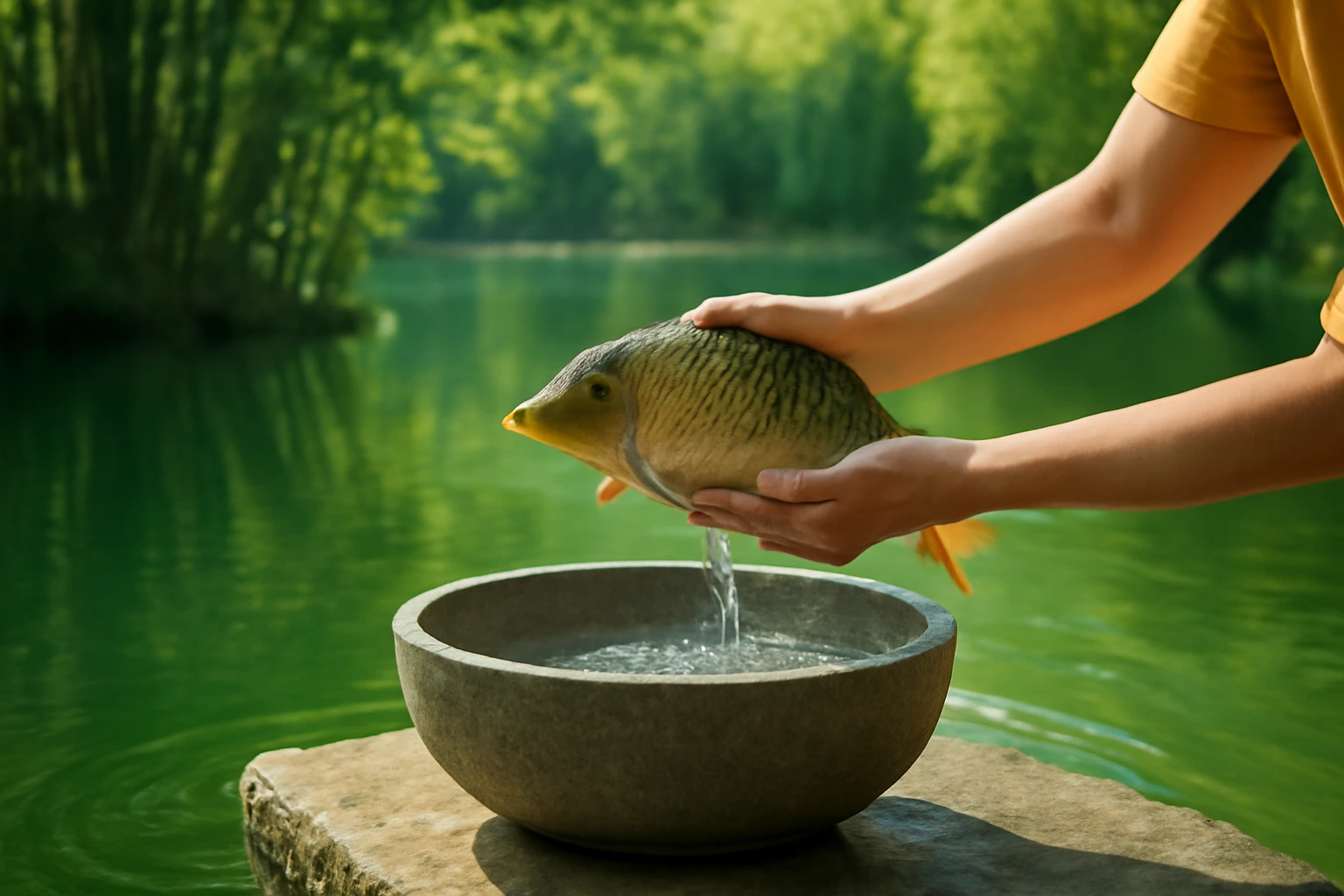
The carp carries a different set of meanings. The legend of the carp that swims upstream and leaps the Dragon Gate, Vũ Môn, to become a dragon is about persistence and transformation, which is why carp images are linked to study, exams and careers. In Chinese, the word for fish sounds like the word for surplus, so carp paintings also suggest abundance.
Vietnam adds a custom of its own. On the twenty-third day of the twelfth lunar month, families honour Ông Công Ông Táo, the Kitchen Gods, who are said to ride carp up to heaven to report on the household's year. Many people release live carp into lakes and rivers that day. If you join in, choose clean water, and put the plastic bag in a bin rather than throwing it in after the fish; litter from this custom is a known problem around city lakes.
A quick comparison
| Money toad | Pi xiu | Carp | |
|---|---|---|---|
| Main meaning | Bringing money in | Keeping wealth, guarding | Perseverance, success, abundance |
| Source story | The tale of Liu Hai and the three-legged toad | Fierce beast in old texts; wealth meaning came later | Leaping the Dragon Gate; fish sounds like surplus |
| Usual place | Shop counter, near the door | Desk, counter, worn as a bracelet | Living-room painting, study desk, aquarium |
| Usual direction | Facing inward | Facing outward | Swimming upstream or into the home |
The table sums up common practice, not fixed rules. Different practitioners will tell you different things, which is itself a reminder that this is a field of custom rather than standards.
Is it fine to display all three?
Nothing forbids it. But a small counter crowded with a toad, a pi xiu, a beckoning cat, a carp and a model sailing ship looks cluttered, is hard to dust and starts to resemble a souvenir stall. One piece that suits your trade and your taste usually looks better. As a rough guide by meaning, traders tend to pick the toad or the pi xiu, while a student's desk or a home where someone is preparing for exams more often has a carp. That is a suggestion based on the stories, not on any measurable effect.
Materials, size and safety
- Stone and bronze figures are heavy; place them on a stable surface, never on a high shelf above where someone sits.
- The loose coin in a toad's mouth is small enough for a toddler to swallow. Glue it in place or keep the toad out of reach.
- Resin and stone-powder figures are lighter and cheaper but chip easily. Natural stone is heavier, cool to the touch and irregularly veined. A trustworthy seller tells you which you are buying.
- Bronze tarnishes over time; wipe it with a dry, soft cloth and avoid harsh chemicals.
Sales claims to be wary of
These three are bestsellers, and with that comes some overselling: "the pi xiu must be ritually consecrated to work, and the higher the fee, the better", "this toad attracts several times more wealth than an ordinary one", "buy today or miss your luck". These are the classic price-equals-power and act-now pitches. A symbol represents a wish; no object guarantees anything about money. Finances are better handled with a plan of your own.
If you want to compare designs and materials, the Vietnamese-language shop Vật Phẩm Phong Thuỷ, which ships within Vietnam, has a section of three-legged money toads; measure the spot you have in mind before choosing a size.