From the year-end meal to hoá vàng: the Tết rituals inside a Vietnamese home, and how to keep them simple
Short answer: the rituals of Tết inside a Vietnamese home follow a pattern of welcoming and sending off. The year-end meal (tất niên) closes the old year, the ancestors are invited home on the last afternoon, New Year's Eve (giao thừa) sees off the old year and greets the new one, the first three days keep incense and food on the altar, and the hoá vàng ceremony sends the ancestors back. Lucky money and New Year visits fill the days in between. Families in a tube house, an apartment or far from their home province can all simplify the routine without losing its meaning, as long as they understand what each step is for.
Other articles here cover the Kitchen Gods and the big clean, first-footing, and the flowers and taboos of the season. This one stitches those pieces into a single timeline, from the last dinner of the year to the day the five-fruit tray is taken down, and focuses on the practical questions: what to do, when, and how to do it safely in your own home.
The big picture: welcome, then farewell
Seen from the ancestor altar, Tết has a clear shape. First come the farewells: the Kitchen Gods leave on the 23rd of the twelfth lunar month, and the old year is closed with the year-end meal. Then the welcomes: the ancestors are invited home on the last afternoon of the year, the new year arrives at midnight, and the first visitor of the year steps through the door on the morning of the first day. Finally another farewell: hoá vàng sends the ancestors back after they have spent the holiday with the family. Seeing it this way helps people avoid getting lost among a long list of rituals, and makes it easier to tell which steps can be simplified without losing their point.
Dates and offerings differ by region, family and religion. What follows is the widespread pattern, not a rulebook. If your Vietnamese family does it differently, follow your family.
The year-end ritual and the last dinner
Tất niên means "end of the year". The offering is usually made on the afternoon of the last day of the twelfth lunar month, the 30th, or the 29th in a short month. Busy families often hold it a day or two earlier so relatives who live far away can attend. The offering is a family meal, richer than usual, which everyone eats together after it has been presented at the altar.
The real point of the meal is to sit down together, talk over the year and thank each other. In cities, companies and groups of friends hold their own year-end parties too, also called tất niên. There is nothing wrong with combining the year-end meal and the welcoming of the ancestors into a single afternoon on the 30th; plenty of families do just that.
Inviting the ancestors home
On the afternoon of the 30th, in many families, incense is lit to invite the ancestors to come home and celebrate. Some families also visit the graves earlier in the month, a custom called tảo mộ, to clean them and light incense. From the moment the ancestors are invited, incense is kept burning on the altar through the holiday, and a bowl of rice and food is usually offered at each meal.
Families who cannot travel to the graves often ask relatives back home to light incense for them, and light incense at their own remote altar in the city. This is a very familiar arrangement and nobody considers it lacking.
New Year's Eve: an offering outside and one inside
Giao thừa is the moment the old year hands over to the new, around midnight between the 30th and the first day. In folk belief, each year has a celestial official who oversees human affairs, and midnight is when the outgoing official hands over to the incoming one. So many families make two offerings.
The outdoor offering
A tray is set up in the yard, in front of the door or on the roof terrace, facing open sky, to see off the old official and welcome the new. It usually holds incense, flowers, fruit, sticky rice cake (bánh chưng) or sticky rice, and in some homes a boiled chicken, rice wine and votive paper. Tube houses often place it right on the pavement in front of the door.
The indoor offering
After the outdoor offering, the family lights incense at the ancestor altar to announce the new year. Many households then exchange wishes and hand out lucky money to the children right after midnight.
In an apartment without a yard
Apartments have no private yard, and many buildings ban fires in corridors and on balconies. You can set the outdoor tray on the balcony or beside an open window, light incense and say a prayer, but do not burn paper there. Take votive paper down to the building's shared burning area, or leave it out. Burning less votive paper does not make the offering less sincere; many pagodas actively encourage people to burn less.
The first three days: incense, meals and the house
During the first three days, many families offer a meal to the ancestors every day, keep incense and lamps going on the altar, and observe familiar taboos: no sweeping the floor or taking out the rubbish, no unlucky words, no arguments. We cover those taboos in detail in peach blossom, kumquat trees and Tết taboos.
The thing to add here is safety. Tết is when homes are crowded, incense and candles burn for hours, the house is decorated with paper, fabric and dry branches, and adults drink more than usual. Keep one rule: candles and incense burn only while someone is at home. Before the whole family goes out visiting or to the pagoda, put out the candles and leave an electric altar lamp on if you want to keep a light.
Lucky money: giving it gracefully
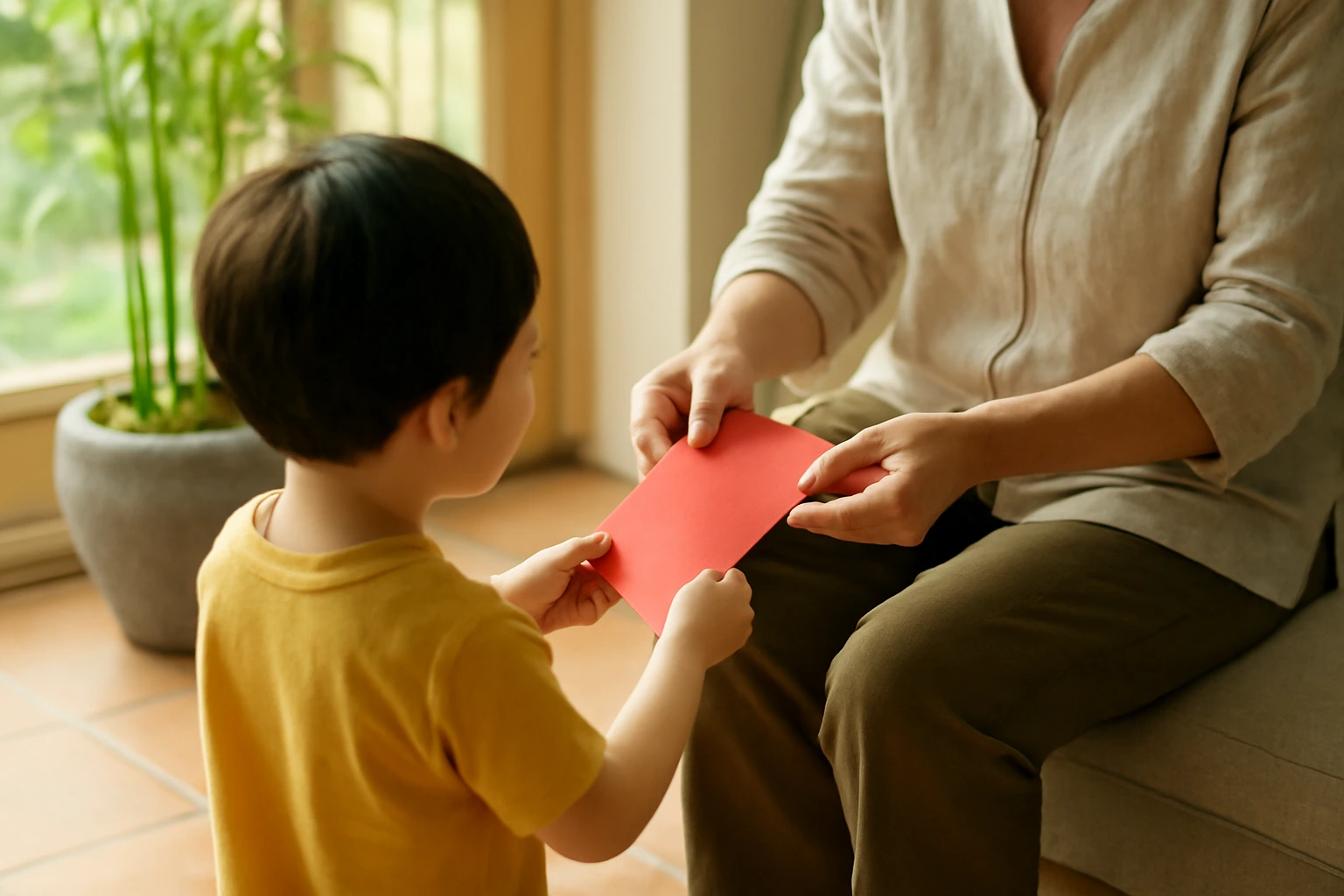
Lì xì, also called mừng tuổi, means giving crisp new banknotes in a small red envelope with a spoken wish. The meaning lies in the wish and the luck of the new year, not in the amount.
Who gives to whom, and when
Adults give to children, adult children give to their parents and grandparents, and employers give to staff when they first meet in the new year. Children usually receive lucky money after wishing the adults a happy new year. Many families teach children to accept with both hands, say thank you and not open the envelope in front of the giver.
Envelopes and notes
Red or gold envelopes, new and flat notes. It does not need to be much. For a child, one new note with a wish to study well and be good is enough. Do not let lucky money become a competition or a financial strain. If your holiday budget is tight, set aside an amount for envelopes in advance and stick to it.
For foreigners and new in-laws
Foreigners living in Vietnam are often advised to keep a few envelopes ready when visiting homes with small children. Nobody judges the amount. Saying "chúc mừng năm mới" (happy new year) in Vietnamese as you hand it over goes down very well.
New Year visits: order, gifts and manners
The saying "day one for father, day two for mother, day three for teachers" sets out the traditional order: the father's side, then the mother's side, then teachers and friends. Schedules are far more flexible now, especially when the two sides of the family live in different provinces. A few small things make visits easier for everyone:
- Bring a modest gift: sweets, candied fruit, tea, fruit, or wine if the hosts drink. Very expensive gifts can embarrass the hosts.
- Arrive mid-morning or mid-afternoon, avoiding mealtimes unless invited.
- Light a stick of incense at your hosts' altar if they invite you to, particularly if someone in the family died during the past year.
- Do not stay too long when the hosts are expecting other visitors.
- Do not drink and ride. Roads are crowded during Tết and a lot of people have been drinking; take a taxi or let someone sober drive.
Hoá vàng: sending the ancestors back
Hoá vàng, literally "transforming the gold", is the ceremony that sends the ancestors back after the holiday, and the moment the votive paper offered over Tết is burned. It is most often held on the third or fourth day; some families wait until the seventh, depending on family custom and when everyone returns to work. Afterwards the daily meal offerings usually stop and the altar returns to its normal rhythm.
Burn the paper in a metal bin, on open ground, away from dry ornamental branches, flags, lanterns and motorbikes, and have someone watch it until the ash is cold. In an apartment, use the building's shared burning spot or burn less. For a bilingual explanation of hoá vàng and related terms, see our glossary of ancestor worship and Tết.
After Tết: putting things away
After hoá vàng, the five-fruit tray is taken down and shared, wilted flowers are replaced, and a kumquat tree is either returned to the nursery if it was rented or looked after if it was bought. Unplug and inspect decorative lights before storing them, because cables left outdoors for days often get damaged. Dried peach and apricot branches should be thrown away properly, not left in a pile under the stairs or the altar, where they are easy kindling.
A reference timeline for Tết at home
| When (lunar calendar) | Ritual or task | Meaning | Simplified apartment version |
|---|---|---|---|
| 23rd of the 12th month | Seeing off the Kitchen Gods | Farewell to the hearth gods | Offer at the kitchen or altar, release fish responsibly |
| Mid to late 12th month | Grave visits, big clean, altar cleaning | Preparing for the new year | Ask relatives at home to visit the graves |
| Afternoon of the 30th (or 29th) | Year-end meal, inviting the ancestors | Closing the year, welcoming ancestors | Combine into one afternoon |
| Midnight | Outdoor and indoor offerings | Old year out, new year in | Tray on the balcony, no burning there |
| Days 1 to 3 | Daily offerings, visits, lucky money | Celebrating with the ancestors | Flames only while someone is home |
| Days 3 to 7 | Hoá vàng | Sending the ancestors back | Shared burning spot or less paper |
| After hoá vàng | Taking things down | Back to normal | Check decorative wiring before storing |
A simpler Tết for busy households, step by step
- Agree with the elders early in the twelfth month. Ask how your family does it: which day for the year-end meal, which day for hoá vàng, who goes back to the home province.
- Write a list of rituals and who is in charge. One person per task, so it does not all fall on one person.
- Prepare envelopes and gifts in advance. Get new notes, fill the envelopes and list the homes you will visit.
- Set up for fire safety. A metal bin for burning paper, a small extinguisher or bucket of water, low-smoke incense.
- Choose offerings you can manage. Sincerity matters more than the number of dishes; a small, clean, tidy tray is perfectly proper.
- Leave room to rest. Do not fill all three days with visits. Older relatives and small children need breaks.
A worked example: a couple's first Tết in their own apartment
A young couple are spending Tết in their city apartment for the first time because the husband is on holiday duty at work. The wife is from abroad and has never done any of these rituals. They phone his mother, who tells them: on the afternoon of the 30th, a modest meal and incense to invite the ancestors; at midnight, a tray of fruit on the balcony; on the third day, hoá vàng.
They buy a box of low-smoke incense and skip votive paper because the building does not allow burning on balconies. At midnight they set fruit and a bánh chưng on the balcony, light incense, then go inside and light incense at their small remote altar. On the morning of the first day, the wife takes a few red envelopes to the neighbours, who have two children, and says "chúc mừng năm mới". On the third day they light incense to see the ancestors off and burn nothing. Afterwards his mother tells them that was plenty, because what matters is that the children remembered the days.
Common mistakes
- Preparing more offerings than you can cope with. Tradition does not demand a banquet from every household.
- Burning votive paper on an apartment balcony or in a corridor. A serious fire risk, and against building rules.
- Leaving candles and incense burning while everyone is out. One of the most common causes of small house fires over the holiday.
- Turning lucky money into pressure. Budget in advance and do not compare.
- Drinking and then riding to visit relatives. No New Year wish is worth more than getting home safely.
When to bring in a professional
For ritual questions, such as prayer texts, regional offering customs or what a family in mourning should do at Tết, ask senior relatives or the local pagoda. Plan holiday spending, lucky money and gifts as part of your own budget, and avoid borrowing to pay for Tết. If older relatives or anyone with heart disease or diabetes will be at the table, ask their doctor about diet over the holiday, because festive food tends to be rich, sweet and accompanied by alcohol. If a fire starts, call the fire service straight away rather than trying to handle it alone for too long. And if you want to understand the first visitor of the year, our guide to first-footing at Tết covers that custom in detail.
If you would like a small good-luck gift to bring on New Year visits, the Vietnamese shop Vật Phẩm Phong Thuỷ, which delivers within Vietnam, has a section of lucky items where you can find something compact that suits the person you are visiting.