A Vietnamese–English glossary of ancestor worship and Tết: from bát hương and giỗ to xông đất and hoá vàng
Short answer: Vietnamese family worship and the lunar new year come with words that foreigners hear constantly but rarely find in a dictionary. Bàn thờ gia tiên is the ancestor altar; bát hương is the incense bowl at its centre; giỗ is a death anniversary, when the family gathers to remember someone; vàng mã is votive paper, burned as an offering; xông đất is first-footing, the first visitor after midnight on New Year's Eve; and lì xì is lucky money in red envelopes. This glossary groups the essential terms, with a short explanation of each and a note on how Vietnamese people themselves tend to describe them.
Many of these words have no true English equivalent. The most natural approach, and the one many Vietnamese English speakers use, is to keep the Vietnamese word and add a sentence of explanation.
The altar and its objects
| Vietnamese | English | What it is |
|---|---|---|
| Bàn thờ gia tiên | Ancestor altar, family altar | The altar for grandparents and earlier generations, placed high in a respectful spot |
| Bát hương | Incense bowl | A bowl of ash or sand that holds incense sticks; the most important object on the altar, never moved casually |
| Thắp hương, thắp nhang | To light incense | The basic act of worship; hương is the northern word, nhang the southern |
| Bàn thờ Thần Tài, Ông Địa | Shop altar | A small floor altar in shops to the god of wealth and the earth god |
| Phòng thờ | Altar room | A dedicated room for the altar, often on the top floor of a tube house |
| Di ảnh | Memorial photo | A photograph of the deceased placed on the altar |
The ritual calendar
- Mùng một and rằm: the first and fifteenth days of each lunar month, when many families light incense and offer fruit and flowers.
- Giỗ: the death anniversary of a family member, counted by the lunar calendar. Relatives gather, cook a meal, offer it at the altar and then eat together. If invited, think of it as a family reunion with a remembrance at its heart rather than a sombre funeral.
- Thanh minh, tảo mộ: the grave-sweeping season, usually around the third lunar month, when families visit and tidy their relatives' graves.
- Vu Lan: the Buddhist festival of filial gratitude on the fifteenth of the seventh lunar month.
- Cúng cô hồn: offerings to wandering souls without descendants, made during the seventh lunar month.
Offerings
| Vietnamese | English | What it is |
|---|---|---|
| Vàng mã | Votive paper, paper offerings | Paper money, gold, clothes and even paper phones or houses, burned so they reach the dead |
| Mâm ngũ quả | Five-fruit tray | A tray of five kinds of fruit on the altar at Tết; the choice of fruit differs between north and south |
| Trầu cau | Betel leaf and areca nut | A traditional offering at ceremonies and weddings |
| Mâm cỗ | Offering feast | A multi-dish meal offered at the altar and then shared by the family |
Practice around votive paper varies enormously between families. There are also public calls to burn less, for environmental and fire-safety reasons, so you will hear a range of opinions.
Tết vocabulary
| Vietnamese | English | What it is |
|---|---|---|
| Tết Nguyên Đán | Tết, Lunar New Year | Vietnamese people prefer "Tết" or "Lunar New Year" to "Chinese New Year" |
| Ông Công ông Táo | The Kitchen Gods | On the twenty-third of the twelfth lunar month, families send the Kitchen Gods to heaven to report on the year |
| Tất niên | Year-end gathering | A last family meal or company party of the old year |
| Giao thừa | The New Year's Eve transition | The moment the old year turns into the new, marked with an offering |
| Xông đất, xông nhà | First-footing | The first person to enter a home after midnight, believed to shape the household's year |
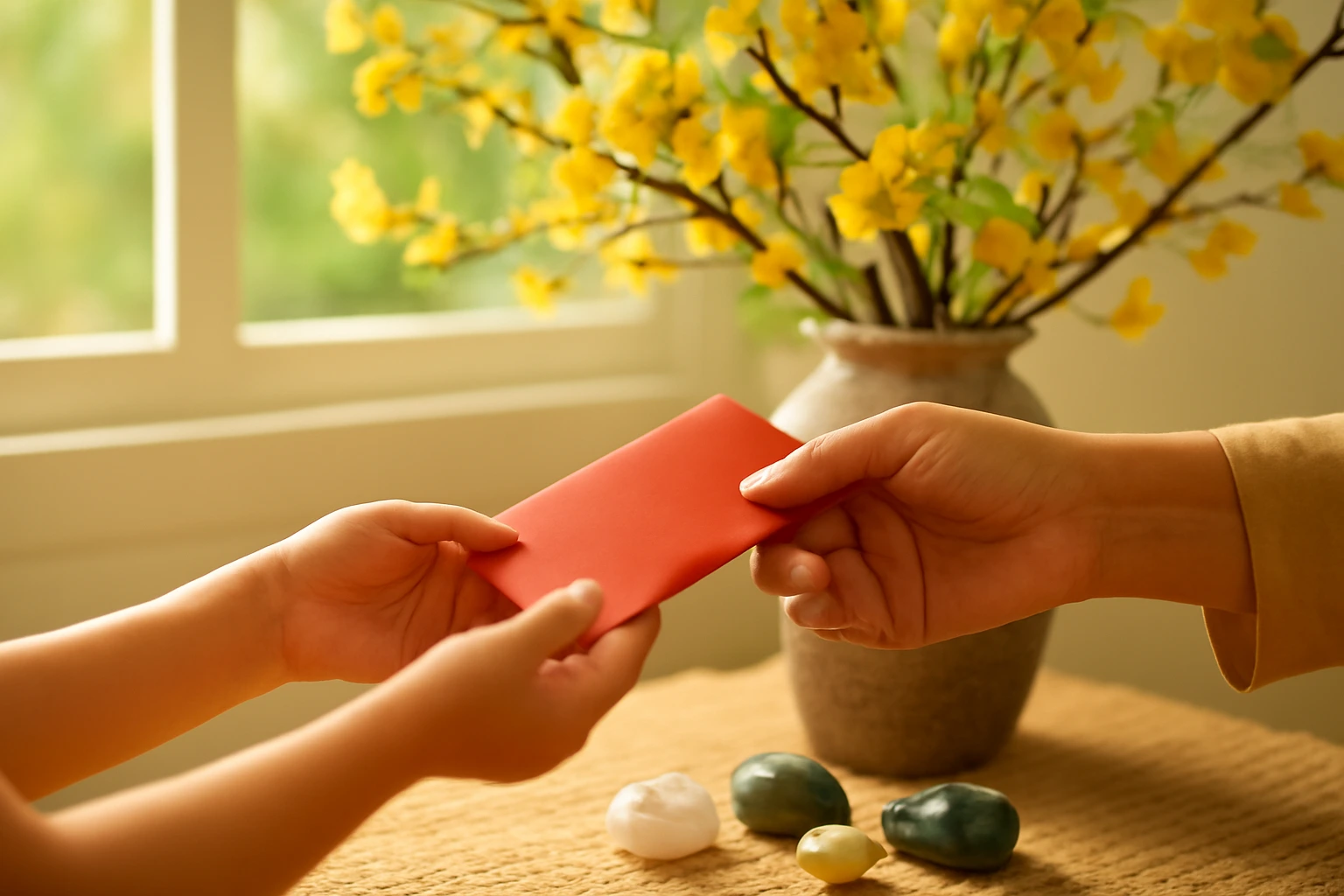
| Lì xì, mừng tuổi | Lucky money | Money in red envelopes for children and elders; the amount is symbolic |
| Hoá vàng | Ending Tết by burning offerings | Votive paper is burned to see the ancestors off, usually on the third or fourth day |
Tết greetings worth learning
A few Vietnamese new year wishes go a long way with colleagues, neighbours and in-laws:
- Chúc mừng năm mới: Happy New Year, suitable for anyone.
- An khang thịnh vượng: peace and prosperity, good for elders and business partners.
- Vạn sự như ý: may everything go as you wish.
- Sức khoẻ dồi dào: wishing you abundant health, ideal for grandparents.
- Học hành tấn tới: may your studies go well, said to children as you hand over lucky money.
Vietnamese people are genuinely touched when a foreigner attempts a greeting in Vietnamese, however imperfect the tones.
Four verbs that are not the same
English tends to translate all of these as "worship" or "pray", but Vietnamese distinguishes them:
- Cúng: to make an offering.
- Lễ: as a noun, a ceremony; đi lễ chùa means visiting a pagoda to pray.
- Khấn: to recite a prayer, usually under one's breath.
- Vái: to bow with palms pressed together.
If you ask a Vietnamese friend whether they "worship" their ancestors, many will gently reframe it as honouring or remembering them, and showing gratitude, rather than worship in the sense of a deity. Using those words yourself tends to land better.
Etiquette that goes with the words
A few things to remember around altars: do not place anything on the altar, do not take food from it until you are invited to share, and do not photograph someone while they are praying. At Tết, if a family asks you to be their first-footer, it is an honour; arrive soon after midnight or early on the first morning, bring a small gift, and keep the conversation cheerful. If you visit during the first days of the new year, red envelopes for the children are appreciated; new, crisp notes are traditional. The Scottish custom of first-footing is a surprisingly close parallel and a handy way to explain xông đất to friends back home.
If your household needs a new incense bowl or altar items before Tết, the Vietnamese-language shop Vật Phẩm Phong Thuỷ, which ships within Vietnam, has a section of altar items and Buddha figures; ask a Vietnamese family member which size suits the altar.