The five elements beyond colour: materials, shapes and directions at home, and how to read a room for balance
Short answer: beyond colour, the five elements (ngũ hành) show up in a home through three other layers: materials (wood, metal, earthenware, water, light), shapes (tall and upright, round, wavy, pointed, square) and directions (east, south, west, north and the centre, according to the Later Heaven bagua). The sensible way to use them is to read a room, see which element dominates and which is missing, then add or subtract to restore balance, rather than treating any of it as a rule. A lot of five-element advice also lines up with comfort you can actually feel: a room of glass and metal feels cold, and adding wood and fabric warms it up.
Our article on the five elements explained covers the elements themselves and the generating and controlling cycles. The piece on choosing colours by your birth element deals with colour. This guide covers the rest: the layers that interior designers and feng shui practitioners in Vietnam use most but rarely explain clearly, and how to combine them when arranging a real room.
Why colour is only the start
Colour is the most visible layer of the five elements, so it is also the most overused: a whole wall painted in a "lucky" colour, with sofa, curtains and rug all in the same shade. In feng shui texts, colour is only one way an element expresses itself. A wooden table painted white is still a Wood material, even though white is a Metal colour. A round brass lamp is a Metal shape and a Metal material, yet the light it gives off belongs to Fire.
Looking at all the layers gives you more options. If you dislike red, you can still "add Fire" with warm lighting. If you do not want to repaint, you can still "add Wood" with plants and wooden furniture. Careful practitioners tend to work this way because it is cheap and easy to undo.
Layer one: materials
Each material in a home is assigned to an element according to its nature. Most of the assignments are fairly consistent; only a few, such as glass and crystal, are classified differently from one book to another.
- Wood (Mộc): timber, bamboo, rattan, sedge, paper, natural fabrics such as cotton and linen, and living plants.
- Fire (Hoả): light, lamps, candles, the cooking flame and, in some texts, leather and animal hair.
- Earth (Thổ): pottery, porcelain, brick, terracotta roof tiles, natural stone, soil and cement. Many texts put crystal here.
- Metal (Kim): brass, iron, steel, aluminium, stainless steel, silver; some texts include white marble.
- Water (Thuỷ): water itself, aquariums, small fountains; mirrors and glass are usually placed here, though some texts put glass under Metal.
City homes in Vietnam today tend to be heavy on Earth and Metal: ceramic floor tiles, concrete walls, aluminium-framed glass doors, stainless steel railings. That is why people are so often advised to add wood, plants and fabric. The advice matches something you can check: wood and fabric absorb sound, so a room echoes less, and plants and textiles soften hard surfaces.
Layer two: shapes
Each element is also associated with a type of form. The classification comes from the classical reading of hills and mountains in landscape feng shui, and has been carried over to furniture, roofs and door frames.
- Wood: tall, upright, columnar, vertical rectangles, like a tree trunk. Pillars, tall bookcases, long curtains.
- Fire: pointed, triangular, pyramidal, like a flame. Steep roofs, cone-shaped lampshades.
- Earth: square, flat, low and heavy. Square tables, ceramic stools, broad steps.
- Metal: round, domed, oval. Round mirrors, round tables, arched doorways.
- Water: wavy, irregular, soft. Free-flowing curves, rugs with wave patterns.
Shapes carry a feeling, too. A room full of sharp corners and diagonals feels hurried; a room of low square blocks feels heavy; a round table or a rug with curved lines calms it down. This is one of the places where feng shui and interior design say almost the same thing in different words.
Layer three: directions within the home
Under the Later Heaven bagua, the arrangement used in most everyday feng shui, the eight directions and the centre of the house are linked to the elements as follows.
| Direction | Trigram | Element | Common suggestion |
|---|---|---|---|
| East | Chấn (Thunder) | Wood | Plants, wooden furniture |
| Southeast | Tốn (Wind) | Wood | Plants, bamboo, wooden wind chimes |
| South | Ly (Fire) | Fire | Light, lamps |
| Southwest | Khôn (Earth) | Earth | Ceramics, stone |
| West | Đoài (Lake) | Metal | Metal objects, round shapes |
| Northwest | Càn (Heaven) | Metal | Metal objects, a brass bell |
| North | Khảm (Water) | Water | Aquarium, a painting of water |
| Northeast | Cấn (Mountain) | Earth | Pottery, stone, ceramic stools |
| Centre | (none) | Earth | Keep it open and clean |
Two things should be said clearly. First, this is what the feng shui texts record; it is not something you can measure. Second, in Vietnam the climate gives some suggestions a local twist: the south and west sides of a house are where the sun is harshest, so instead of "adding Fire" there, people usually need shade. For the terms used here, such as trigram, sitting and facing directions, see our glossary of house and direction terms.
Getting the directions right
Using directions only makes sense if you measure them correctly. Stand in the middle of the home with a compass or a phone compass app, away from steel frames, fridges and speakers. In a reinforced concrete apartment block, a phone compass can be off by a noticeable amount, so take readings in several places or check against a satellite map of the building. Getting the direction wrong by one sector puts an object in the wrong element entirely.
Putting the layers together: reading a room
Practitioners rarely apply one layer at a time; they read the room as a whole. These steps let you do the same yourself.
- List the main materials. Floor, walls, ceiling, large furniture, curtains. Note which element each belongs to.
- Look at the shapes. Is the room dominated by square blocks, tall verticals or curves?
- Note the light. Where does daylight come from? Are the bulbs warm or cool white? Is the room bright or dim?
- Identify the dominant and the missing elements. For example, tiles, concrete, aluminium and stainless steel mean Earth and Metal dominate, while wood, plants and warm light are missing.
- Add what is missing with reversible items. A pot plant, a wooden shelf, fabric curtains, a warm lamp. Do not repaint or rebuild yet.
- Check the cycles. To soften too much Metal you can add Water (Metal generates Water, which "drains" Metal) or a touch of Fire (Fire controls Metal), but only as accents.
- Live with it for two weeks, then adjust. How the people who live there actually feel is the final test.
A worked example: an apartment living room full of glass and metal
A newly handed-over apartment has a living room with grey ceramic tiles, a wall of aluminium-framed sliding glass doors onto the balcony, stainless steel railings, cool white ceiling lights and a glass coffee table on iron legs. The owners find it bright but cold. Conversations echo, and they never quite relax there in the evening.
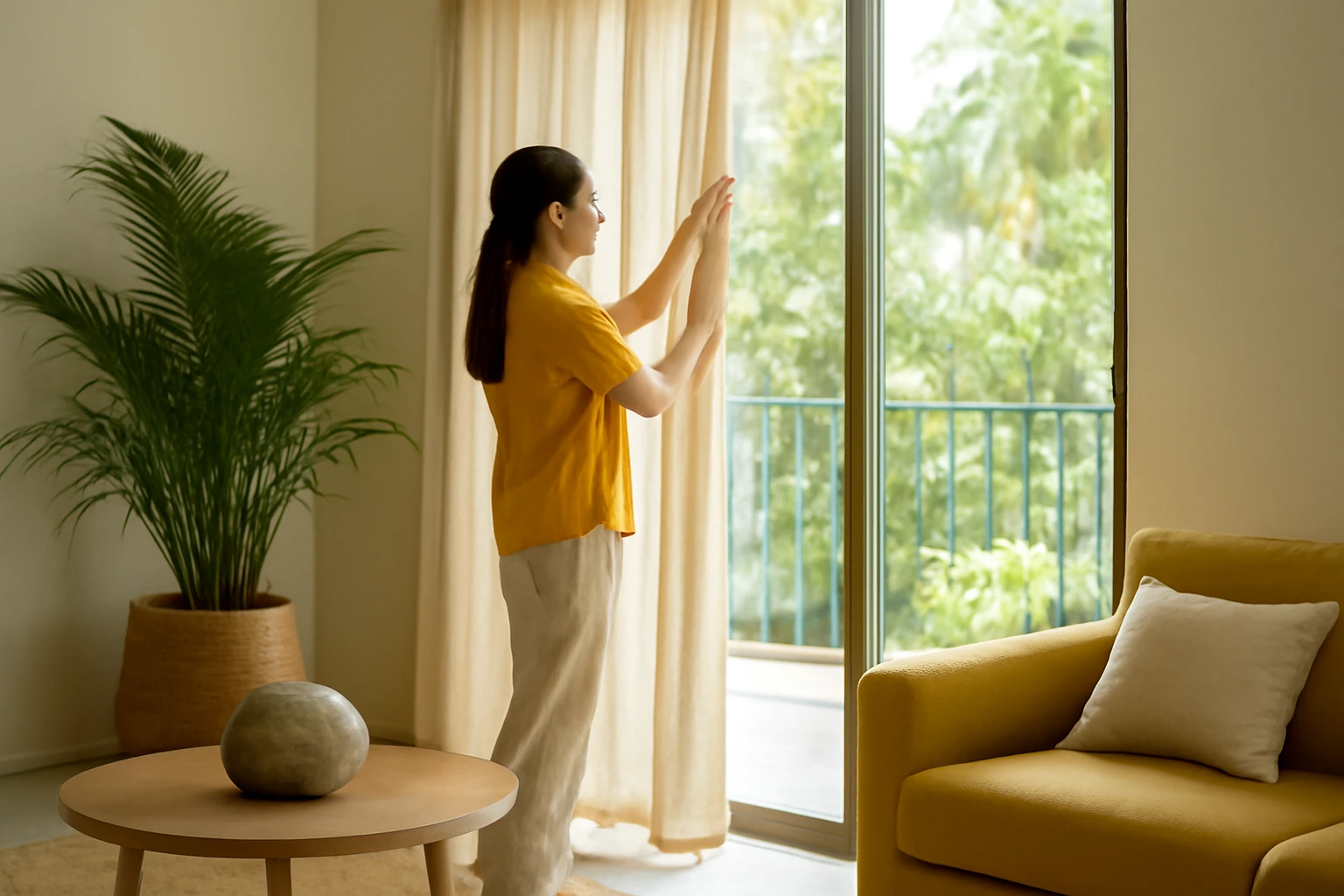
Read through the five elements, the room has too much Metal and Earth, some Water in all that glass, and very little Wood or warm Fire. They make a few changes: swap the glass coffee table for a round wooden one, put two large-leaved plants beside the balcony doors, hang beige linen curtains and add a warm floor lamp in one corner. No repainting, no remedy objects. The room echoes less because fabric and wood absorb sound, and evenings feel easier under warm light. It is a good illustration of how, when you treat the five elements as a way of observing, the results usually match ordinary interior design experience.
Aquariums, plants and candles: three "element" items that need care
An aquarium for Water
Aquariums are often recommended for the north, east or southeast. Before following that, think about weight: a large tank full of water is very heavy and needs a sturdy stand and a floor that can carry it. Pumps, lights and heaters need sockets with residual current protection, and cables must not run where water can drip. Homes with small children need a lid. A dirty tank with dead fish that nobody looks after is bad news for both feng shui and hygiene. If you do not have time, many people consider a painting of a river or the sea enough of a Water accent.
Plants for Wood
Plants are the easiest way to add Wood. Choose ones that suit the real light in the room. Some common houseplants, such as dumb cane (sometimes sold in Vietnam as vạn niên thanh), have sap that irritates the mouth if chewed, so keep them out of reach of small children and pets. Replace or revive wilting plants: folk belief says a dead plant indoors is a bad sign, and common sense says it attracts mould and insects.
Candles and lamps for Fire
The easiest way to add Fire is warm electric light; you do not need a real flame. Scented candles and decorative oil lamps are lovely, but they are ignition sources. Keep them away from curtains, never leave them burning when you sleep or go out, and keep them out of children's reach.
Quick reference: the five elements at home
| Element | Materials | Shape | Direction | Easiest way to add it | Watch out for |
|---|---|---|---|---|---|
| Wood | Timber, bamboo, rattan, natural fabric, plants | Tall, upright | East, southeast | Plants, wooden shelves | Toxic sap, dying plants |
| Fire | Lamps, candles | Pointed, triangular | South | Warm lighting | Candles near curtains, children |
| Earth | Pottery, porcelain, brick, stone | Square, flat | Southwest, northeast, centre | Ceramic vases, stools | Keep heavy items low |
| Metal | Brass, iron, steel, aluminium | Round, domed | West, northwest | Metal frames, a brass bell | Sharp edges, heavy items hung high |
| Water | Water, mirrors, glass | Wavy | North | Painting of water, small aquarium | Electricity near water, mosquitoes |
Common mistakes
- Treating directions as orders. Putting an aquarium in the north when that spot is next to a socket and a walkway trades safety for symbolism.
- Trusting a phone compass in an apartment without checking. Steel and electrical equipment deflect it, and you end up in the wrong element.
- Overdoing one element. The five elements are about balance; a home so full of plants that it is dark has too much Wood, not more luck.
- Buying expensive objects to "boost" an element. A warm lamp, a pot plant or a ceramic vase does the same job for far less. "The more it costs, the stronger it works" is a sales tactic.
- Blaming every misfortune on an object in the wrong place. Health, money and relationships have real causes that need real solutions.
When to bring in a professional
A large aquarium or an indoor or rooftop pond needs an engineer to check floor loading and waterproofing. Wiring for aquariums and outdoor decorative lights is a job for an electrician. If a child or pet chews a plant and shows any unusual symptoms, see a doctor or a vet straight away. And if your family wants a reading in a more complex school such as Flying Stars, which brings in time cycles, ask an experienced practitioner and get them to explain their method before you pay.
If you would like a small stone or mineral piece as an Earth or Metal accent on a bookshelf, the Vietnamese shop Vật Phẩm Phong Thuỷ, which delivers within Vietnam, has a section of feng shui gemstones; choose something sized for the shelf, set it securely and keep it away from small children.