Where to sit in an open-plan office: the feng shui command position and what to do without it
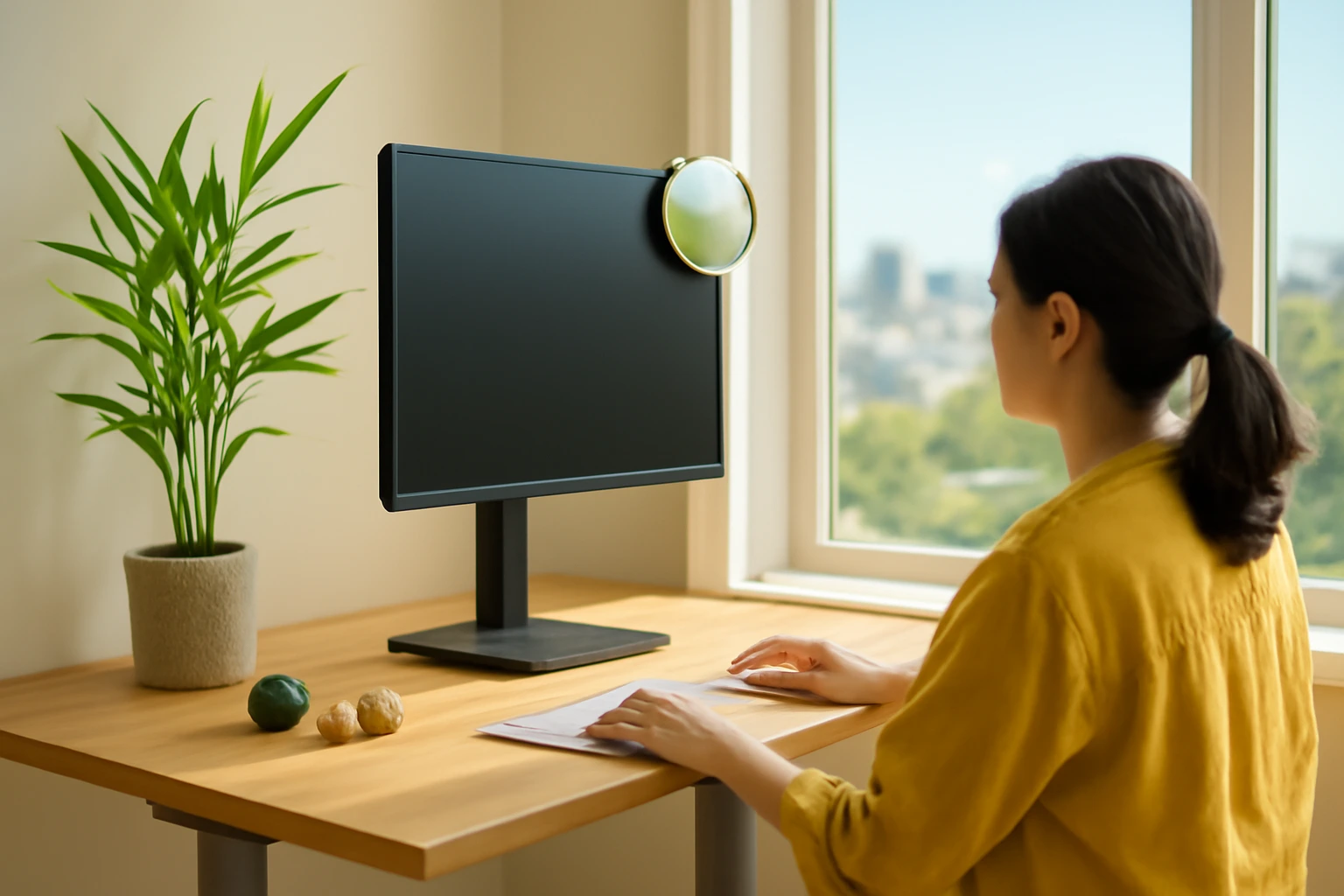
Short answer: the feng shui "command position" is a seat with a solid wall behind you and a clear view of the entrance, without sitting directly in line with the door. In an open-plan office you usually cannot choose your desk, but you can still adjust the angle of your screen, add a low screen or shelf behind your chair, or clip a small mirror to your monitor so you can see who is approaching. Most of this advice has a plain practical reason behind it.
If you work in a Vietnamese company, or manage Vietnamese staff, you may find that colleagues have firm views about who sits where. This article explains where those views come from, which parts are belief and which are common sense, and what you can do with the desk you have been given.
Where the idea comes from
Classical feng shui describes the ideal site for a house as having mountains behind and open space in front. Applied to a single chair, that becomes a wall at your back and an open view ahead towards the entrance. English-language books call it the command position; Vietnamese speakers often just say tựa lưng, nhìn cửa, "back to the wall, eyes on the door".
Strip away the landscape metaphor and you are left with something most people feel instinctively. Having people walk behind you, where you cannot see them, is unsettling. Every footstep pulls your attention, and over a day that adds up to fatigue you cannot quite explain. Anyone who has had a desk next to the corridor in a busy office knows the feeling.
Seats people avoid, and the real reasons
| Seat | The feng shui explanation | The practical explanation |
|---|---|---|
| Back to the door or corridor | No support behind you; vulnerable to being "stabbed in the back" | Constant distraction and being startled |
| Directly in line with the entrance | Energy rushes straight at you | Draughts, noise, and everyone who walks in sees your screen |
| Under a beam or an air-conditioning vent | A beam presses down; cold energy strikes you | A constant cold draught dries the eyes and stiffens the neck |
| Next to the toilets or the printer | Stale, impure energy | Smells, noise, people queuing beside your desk |
| Facing the sharp corner of a pillar or cabinet | "Poison arrows" from sharp angles | Bumping into it, and a cramped feeling |
Almost every rule in the table has a practical twin. If you want to ask for a different seat, the practical reasons will carry more weight with a manager than talk of energy.
If your back faces the walkway
This is the most common problem, and it is cheap to soften:
- A low partition or bookcase behind your chair, roughly shoulder height when seated. It does not need to enclose you, just give a sense of something at your back.
- A small mirror clipped to the side of your monitor, like a rear-view mirror, so you see people coming. Feng shui practitioners recommend the same thing.
- A high-backed chair, which supports your back and screens you a little.
- Noise-cancelling headphones when you need deep focus, if office culture allows it.
Air conditioning, sun and the tropical office
Offices in Vietnam run air conditioning for most of the year, often at a low temperature. Sitting directly beneath a vent can mean dry eyes, a blocked nose and a stiff neck. Ask facilities for a deflector on the vent, keep a light jacket at your desk and drink water steadily through the day. If headaches or eye irritation persist, see a doctor rather than blaming the seat's energy.
West-facing windows bring harsh afternoon sun across your screen. Roller blinds or heat-reflective window film help, and turning the monitor so it sits at a right angle to the window rather than facing it cuts glare noticeably.
Ergonomics, which feng shui largely ignores
Traditional texts say little about desk height, yet this is what decides how sore you feel at six o'clock. A few checks:
- The top edge of the screen at or slightly below eye level.
- Elbows at roughly a right angle when typing, shoulders relaxed.
- Feet flat on the floor or on a footrest.
- Stand up and move for a few minutes roughly every hour.
Persistent back pain or tingling hands are a matter for a doctor or physiotherapist, not for a lucky object.
A note on Vietnamese office culture
You may notice that in many Vietnamese offices, managers sit in an inner corner with a view over the room, and that senior staff get seats against walls. Some of this is feng shui, much of it is hierarchy, and the two reinforce each other. You may also find a small altar to Thần Tài, the god of wealth, near reception, and colleagues who would prefer not to sit facing it or with their back to it. If someone asks to swap seats for reasons you do not share, accommodating them where possible costs little and builds goodwill.
If you are arranging seating for a team, give quiet corners to people who need long stretches of focus, aisle seats to those who are constantly in and out, and ask people what they prefer. A seating plan made with input draws fewer complaints than one made from a book.
Do not move desks because of a scare
Be wary of advice along the lines of "sit there and you will lose your job" followed by an offer of an object to neutralise the danger. That is creating fear in order to sell the cure. If a seat genuinely bothers you, raise it with your manager in practical terms: noise, cold, glare, foot traffic.
If you would like a small object on your desk that helps you feel settled, such as a polished stone sphere, the Vietnamese-language shop Vật Phẩm Phong Thuỷ, which ships within Vietnam, has a range of feng shui stones for the desk; pick something compact that leaves room for your keyboard and papers.