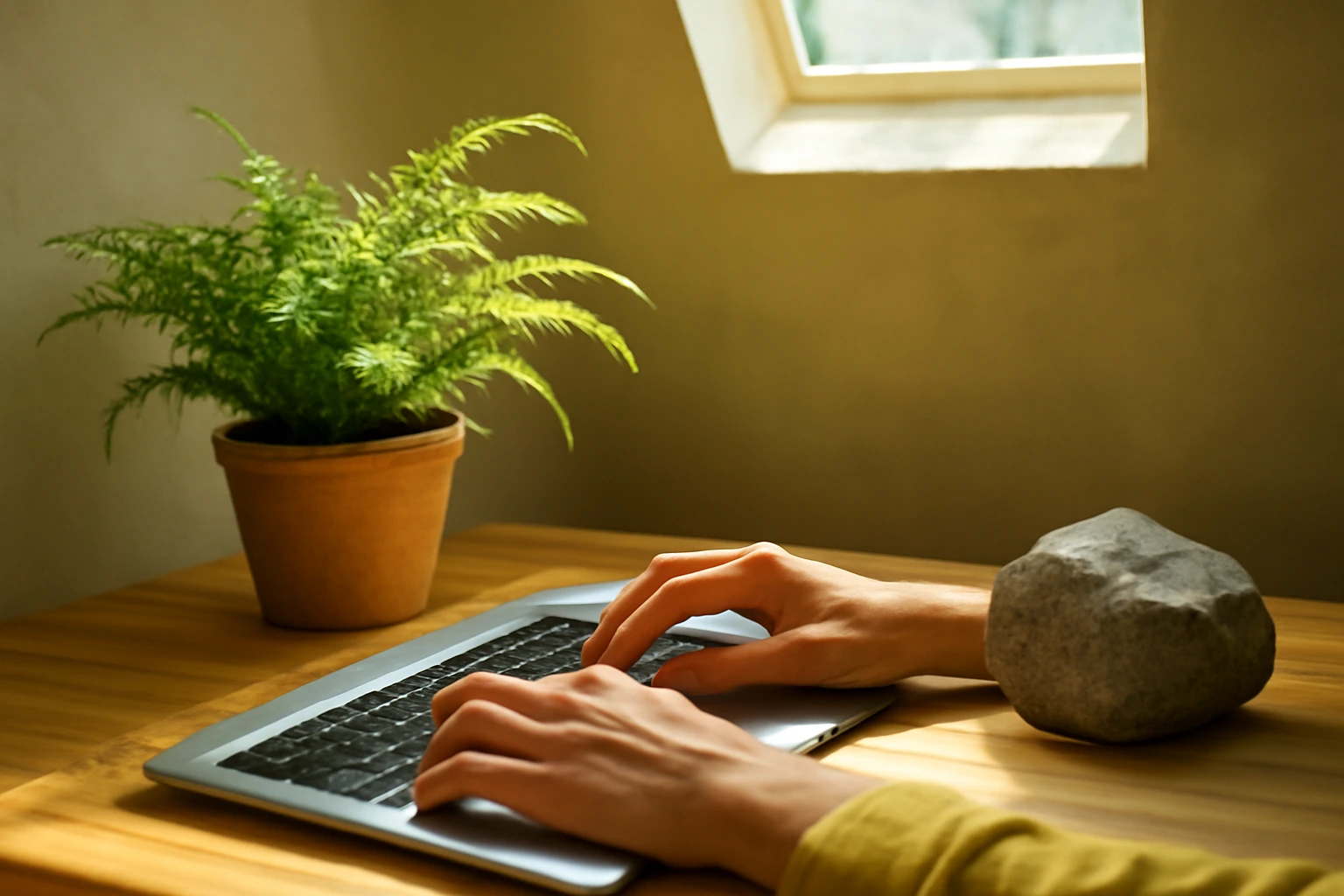
Setting up a home office in a Vietnamese apartment or tube house: light, noise and the bed problem
Short answer: in a small Vietnamese apartment or a narrow tube house, the best place for a desk is usually somewhere with daylight coming from the side, a wall behind your chair, no direct view of the bed and no overlap with the dining table. Feng shui advises keeping work and sleep apart because the active energy of work disturbs the stillness a bedroom needs. Sleep specialists say much the same in different words: a bed you can see from your desk makes it harder to switch off.
Plenty of foreigners in Vietnam work remotely from rented homes that were never designed with an office in mind. This guide covers the specific challenges of local housing and how to set up a workspace that lets you concentrate.
Why local housing makes this tricky
The nhà ống, or tube house, is narrow and deep. Daylight comes in from the front and sometimes from a light well, and the rooms in the middle are often dim. Apartments in newer buildings are compact, with an open living room and kitchen and bedrooms just big enough for a bed and a wardrobe. Few rentals include a study. Add street noise, the neighbours' renovation drilling, which can go on for weeks, and in many cases a landlord's family living downstairs, and finding a calm spot takes some thought.
The practical question, then, is rarely "which compass direction is best". It is "which corner is bright enough, quiet enough and out of everyone else's way".
Three common locations compared
| Desk location | Advantages | Watch out for |
|---|---|---|
| A corner of the living room near a window | Bright, airy, separate from sleep | Household traffic, the television, visitors |
| In the bedroom | Quiet, door can be closed | Work bleeds into rest; harder to fall asleep |
| A stair landing or the top-floor altar room of a tube house | Uses otherwise wasted space | Often dark and hot; the altar room is a sacred space |
That last point deserves a note. Many tube houses have a phòng thờ, an altar room, on the top floor, holding the bàn thờ gia tiên (ancestor altar). Vietnamese families generally avoid putting a work desk there, since it is meant for worship and quiet. If you rent a house with an altar room, ask the landlord before using it for anything else, and if you must, keep your desk well away from the altar and never sit with your back pressed against it.
When the desk has to go in the bedroom
This is the reality for many renters. A few ways to keep the two functions apart:
- Position the desk so that when you sit, the bed is behind you or to the side rather than in front of your eyes.
- Use a low bookcase, a curtain or a folding screen as a symbolic divider.
- At the end of the day, close the laptop and put papers in a drawer. A clear desk tells your brain the working day is over.
- Do not work from the bed itself; once it becomes a workplace, it stops being restful.
Light and which way to face
Light from the side is the most comfortable: no glare on the screen and no shadow of your hand across paper. Sitting with your back to a window floods the screen with reflections; facing the window makes your eyes adjust constantly between bright sky and screen.
In the dark middle rooms of a tube house, combine a neutral-white desk lamp with enough ceiling light that the contrast between desk and room is not extreme. Feng shui calls long-dark corners heavy with âm khí, yin energy. In practice, poor light just tires your eyes faster.
Heat, humidity and noise
Front rooms facing the street are bright but loud; heavy curtains and well-sealed windows take the edge off traffic noise. Upper floors of tube houses heat up in the afternoon, so position fans or air conditioning so the airflow does not hit the back of your neck all day. In northern Vietnam, the late-winter nồm season brings extreme humidity, when walls and floors literally sweat. Electronics and documents suffer; a dehumidifier or desiccant packs in the drawer where you keep passports and contracts are worth having.
Cables and safety
A home office comes with chargers, a lamp, a second monitor and a router. Check that:
- You are not overloading a single power strip, and the strip sits off the floor where it will not get wet when the floor is mopped.
- No cables cross walkways where elderly relatives or children could trip.
- You never leave laptops or phones charging on the bed or under a pillow.
- If there are small children, unused sockets are covered and small items such as paper clips or button batteries are out of reach, since a child can swallow them.
Video calls: what is behind you
Working from home means colleagues and clients see part of your home through the camera. Before an important call, sit down and check the frame. Things you probably do not want on screen include an unmade bed, laundry drying on a rack, the bathroom door and, if your rental has one, the family altar. An altar is nothing to be embarrassed about, but many landlords and Vietnamese housemates would rather not have a place of worship appear in a work meeting, and viewers may feel awkward too. A plain wall, a bookshelf or a large plant makes a calm background. Put your main light source in front of you or slightly to one side; with a window behind you, your face turns into a silhouette. In a noisy street-facing room, a headset with a close microphone helps a great deal, and telling the household when your calls are scheduled saves you from someone shouting up the stairs mid-sentence.
Sharing a home with a Vietnamese family
If you live with a Vietnamese partner's family or rent a room in a family home, working from home can look like being free. Explain your working hours and meeting times clearly. A simple signal, headphones on or the door closed, helps everyone know when not to call you. In return, avoid setting up in shared walkways or in the spot where grandparents like to drink their morning tea.
If you would like one small object on your home desk, something compact and easy to dust is enough. The Vietnamese-language shop Vật Phẩm Phong Thuỷ, which delivers within Vietnam, has small amethyst pieces for desks; choose a stable shape and keep it away from the edge if children are around.